The Age of Ice
Before the electric refrigerator transformed daily life in the mid-20th century, the world depended on a vast, largely forgotten industry: natural ice harvesting. For more than a century, hundreds of thousands of workers carved blocks of frozen water from lakes, rivers, and ponds every winter, then stored and shipped them across oceans to keep food fresh, cool beverages, and save lives in hospitals.
At its peak in the 1890s, the global ice trade employed an estimated 90,000 people in the United States alone, with an industry capitalised at $28 million. Norway exported a million tons of ice per year. Ice was the second-largest export from the United States, behind only cotton.
Ancient Origins
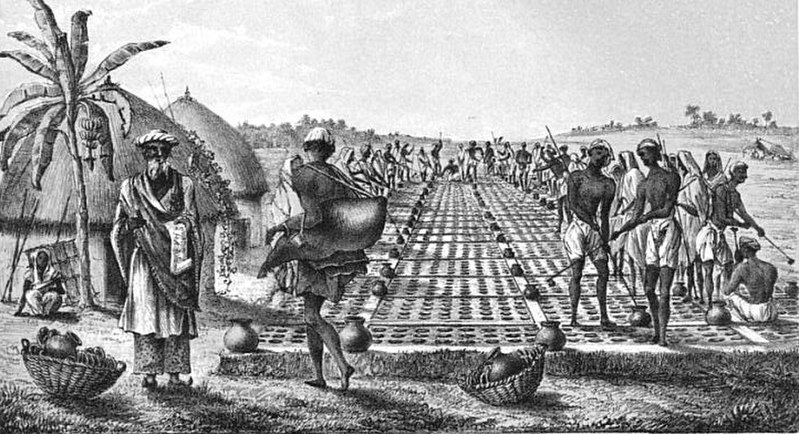
The desire to preserve cold is as old as civilisation itself. As early as 1750 BCE, Mesopotamians constructed deep ice houses along the Euphrates River, collecting winter ice for summer use. Around 500 BCE, Egyptians and Indians placed water in porous clay pots on beds of straw, where rapid evaporation under the cool night sky could create thin layers of ice. The Greeks and Romans used ice to cool wine — Emperor Nero famously had snow and ice transported down from the mountains.
In China around 1000 BCE, the Zhou Dynasty established a specialised "ice administration" with 80 employees who collected natural ice each December. Senior officials received ice as a mark of imperial favour.
The Commercial Revolution
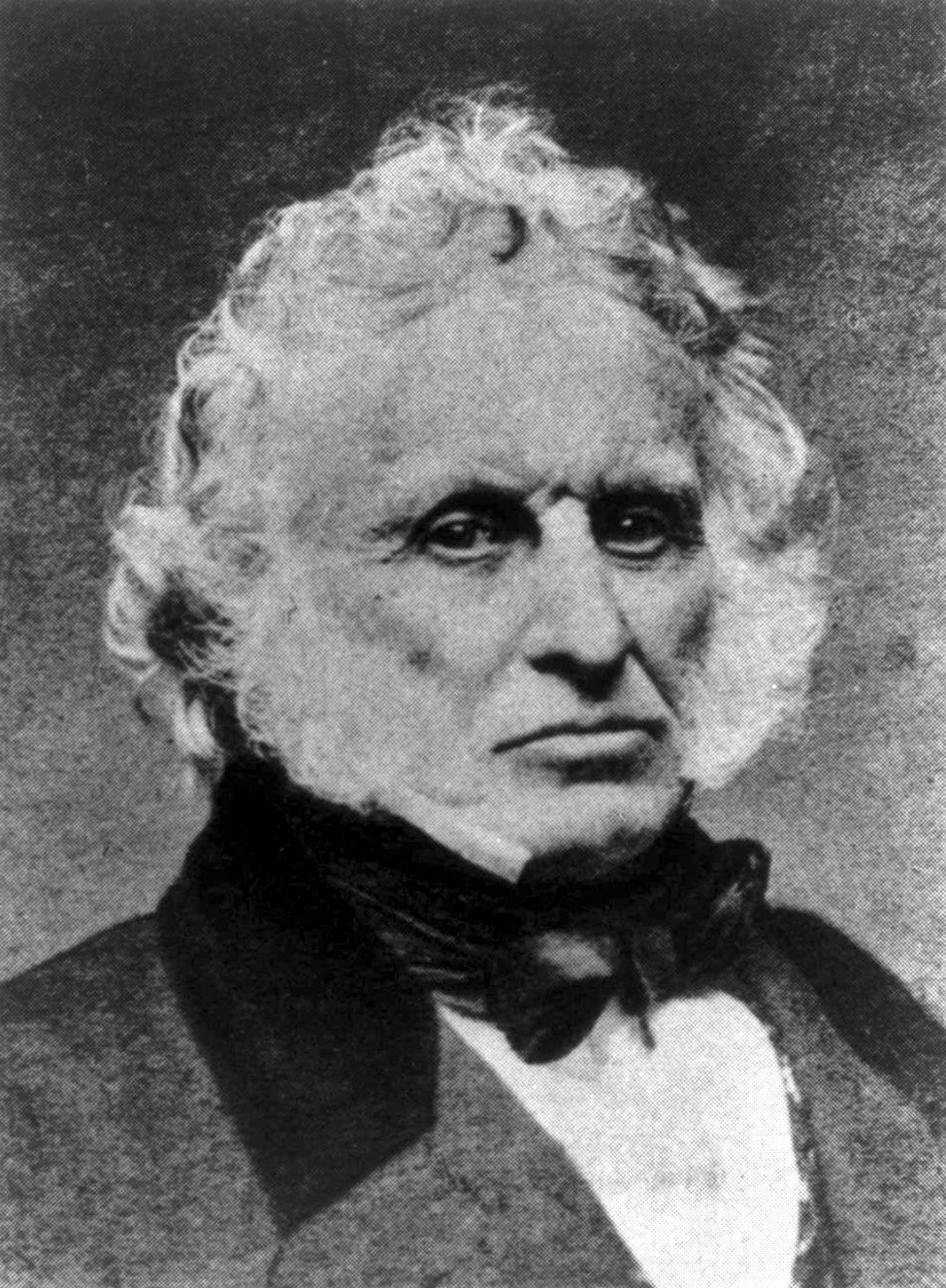
The leap from small-scale ice storage to a global trade was the work of one man: Frederic Tudor of Boston, Massachusetts. In 1806, the 23-year-old Tudor loaded 130 tons of ice onto his brig Favorite and shipped it to the Caribbean island of Martinique. The venture was a financial disaster — he lost $4,500 — and subsequent shipments to Havana fared little better. Tudor even spent time in debtor's prison in 1812–13.
But Tudor persevered. By 1833, he managed to ship ice all the way to Calcutta, India — a four-month voyage. Of the 180 tons loaded in Boston, 100 tons survived the journey. Calcutta became enormously profitable: Tudor made over $220,000 (equivalent to $4.7 million today) from the Indian trade between 1833 and 1850.
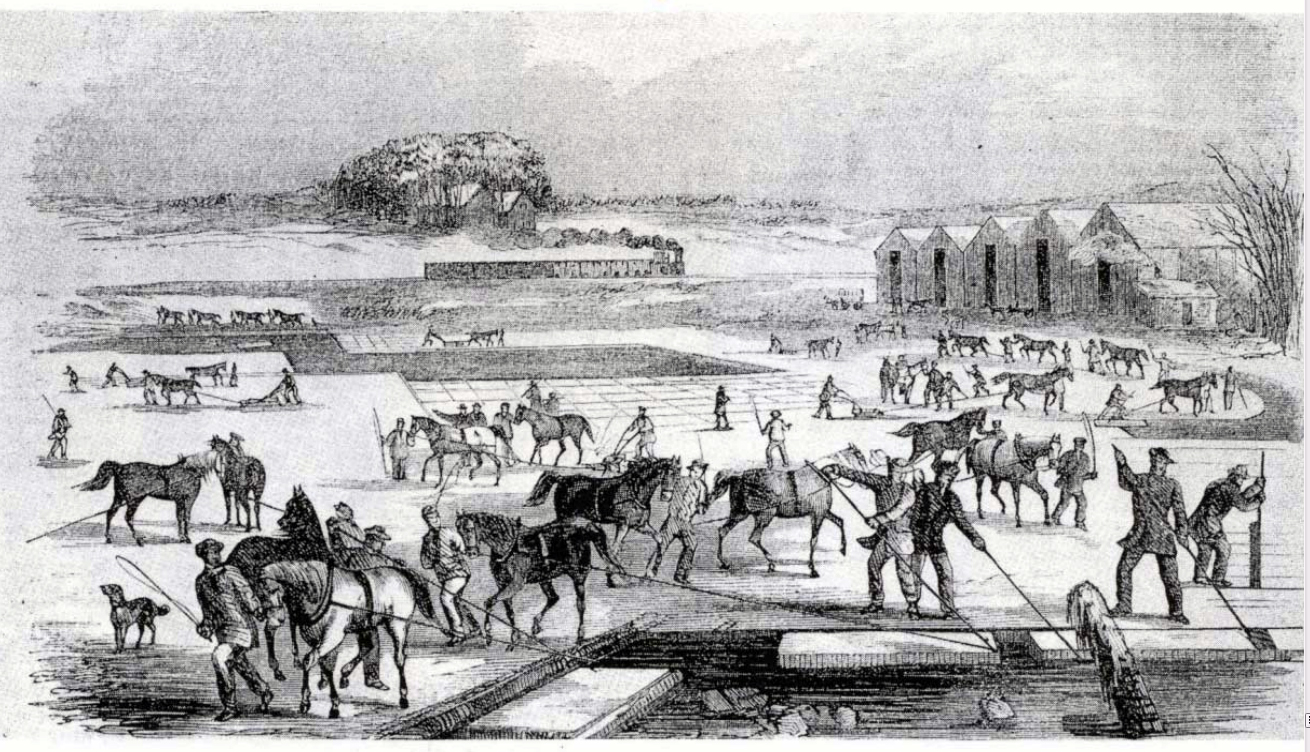
A key partner was Nathaniel Wyeth, who in the 1820s invented the horse-drawn ice plow — a device that scored ice into uniform grids, tripling harvesting efficiency and reducing costs from thirty cents per ton to just ten cents. Wyeth also invented aboveground ice houses with double-wall insulation. As the Dictionary of American Biography noted at his death, "practically every implement and device used in the ice business had been invented by Nat Wyeth."
Peak and Decline
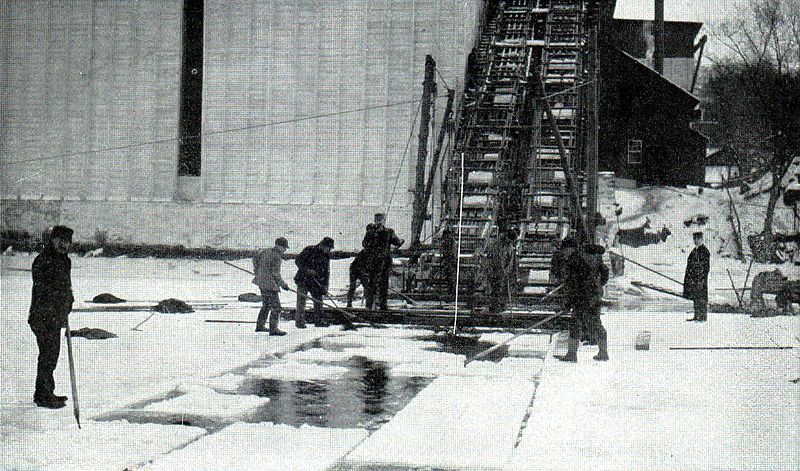
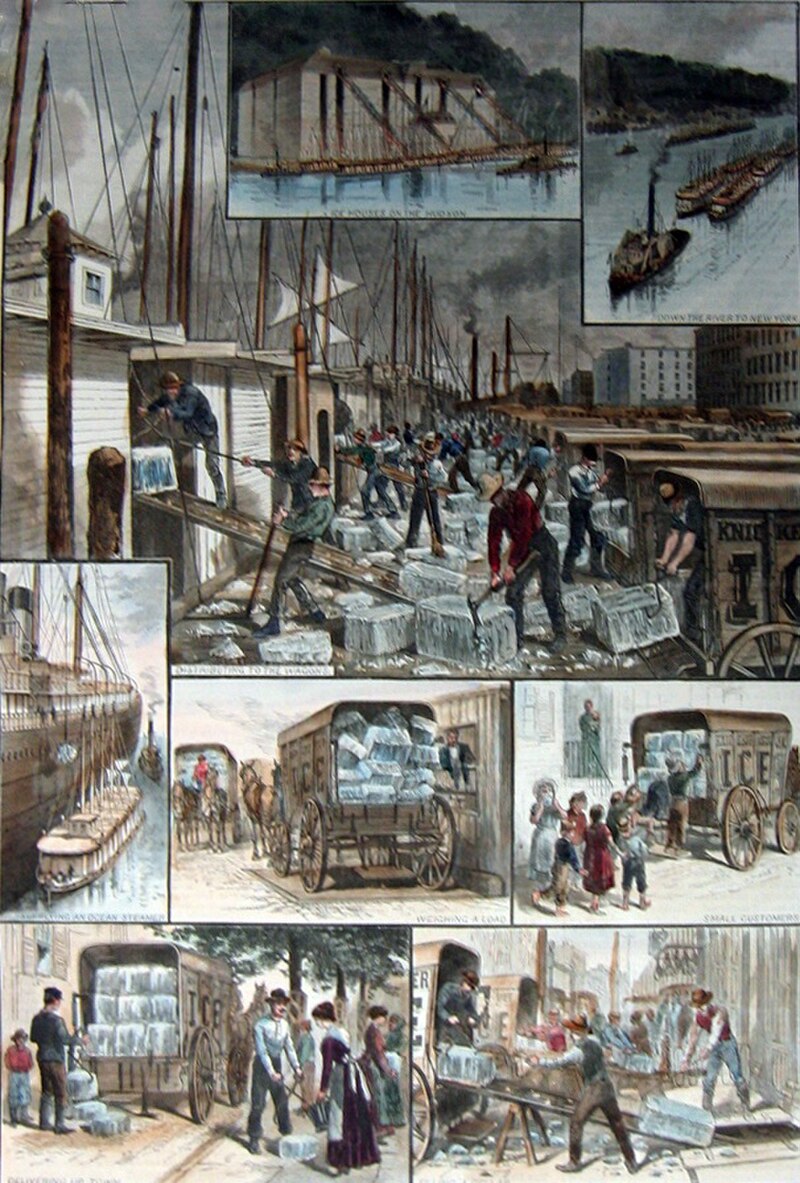
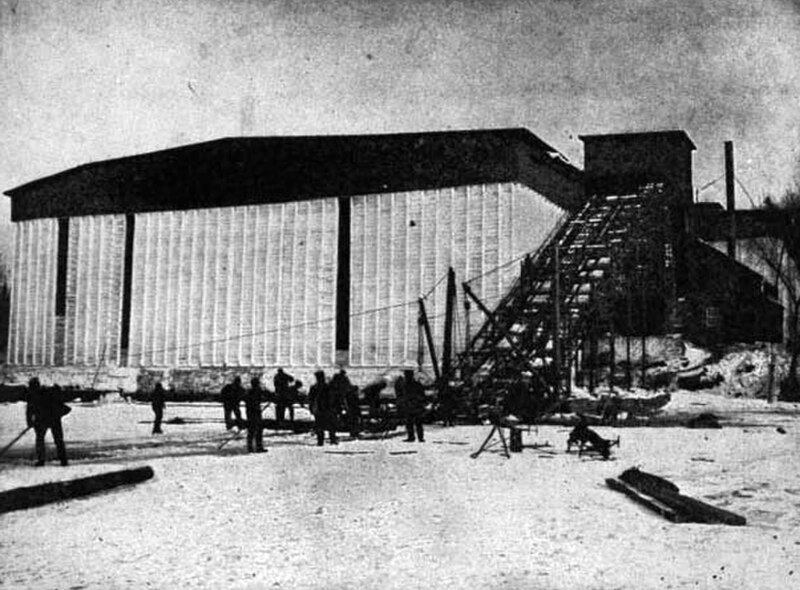
By the 1880s, the ice industry had reached staggering proportions. In the Hudson Valley alone, 20,000 workers harvested ice from the river between Poughkeepsie and Albany, stored in 135 specially built ice houses. In 1886, 25 million tons were cut and stored or shipped in the US alone. The industry provided crucial winter employment for farmers, brickyard workers, sailors, and river pilots.
But the seeds of decline were already planted. Warm winters caused periodic "ice famines" (the first on the Hudson in 1860), while industrialisation contaminated natural water sources. The race toward mechanical refrigeration had begun: Jacob Perkins built the first practical refrigerating machine in 1834, John Gorrie first mechanically produced ice in 1844 (Tudor reportedly ran a smear campaign against him), and James Harrison built the first commercially viable system in 1854. Carl von Linde's brewery refrigeration (1870) was the beginning of the end.
By 1914, more factory-made ice was produced in the US than natural ice. General Electric's Monitor Top refrigerator (1927) brought mechanical cooling into homes, and by 1950, 90% of American city homes had refrigerators. The last major ice harvesting operations ceased in the 1950s — though Plzensky Prazdroj in Czechia remarkably continued until 1987.
The Ancient World of Ice
Long before Frederic Tudor shipped his first block, civilisations across the globe had been harvesting, storing, and even manufacturing ice for millennia. From Mesopotamian kings to Song Dynasty street vendors, the story of cold is as old as civilisation itself.
The Ancient Near East
🏛 Mesopotamia — The Oldest Written Record
King Zimri-Lim’s Ice House (c. 1780 BCE)
A cuneiform tablet from the palace archives of King Zimri-Lim of Mari (now in the Louvre, catalogue AO 20161) records the construction of an ice house (bit shurpim) in the nearby city of Terqa on the Euphrates. This is the earliest known written record of an ice storage facility. Other tablets from the same archive — part of a collection of nearly 25,000 cuneiform tablets unearthed from the Mari palace — discuss obtaining ice to cool the king’s drinks, showing that ice was already considered essential to royal comfort nearly 4,000 years ago.
🏛 Persia — The Yakhchāl Masters
Yakhchāl: Desert Ice Houses (from c. 400 BCE)
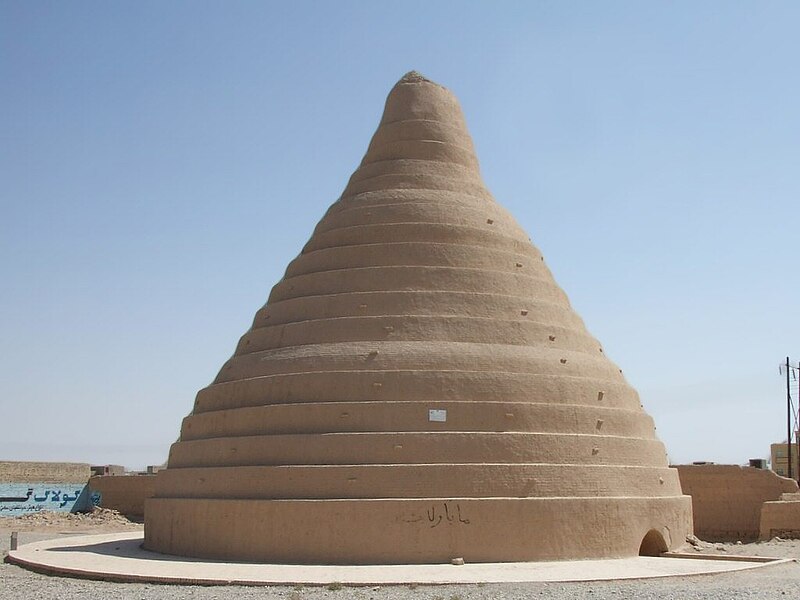
The Persian yakhchāl (literally “ice pit”) is arguably the most sophisticated ancient ice storage system ever built. Dating from at least 400 BCE during the Achaemenid period, these dome-shaped structures featured deep subterranean chambers typically 7–8 metres deep. Their walls were built from sarooj — a specialised mortar of sand, clay, egg whites, lime, goat hair, and ash — up to 2 metres thick at the base, completely waterproof and highly heat-resistant.
Tall shade walls (10–15 metres high) were built east-to-west nearby to block sun and reduce convection losses. Many incorporated badgirs (wind catchers) that diverted breezes downward into the structure, and qanats (underground water channels) that supplied additional cool air. The combination created a passive refrigeration cycle with no moving parts and no energy input — perhaps the most sophisticated passive climate control system in the ancient world. Many original structures still stand in Iran’s Yazd Province. Remarkably, yakhchāl remains the modern Persian word for “refrigerator.”
Making Ice Above Freezing
Perhaps the most counterintuitive ancient technology: in arid desert climates, Persians could make ice even when air temperatures never dropped below freezing. The physics relies on an atmospheric transmission window between 8 and 13 microns wavelength, where infrared radiation escapes directly into space (at roughly −270 °C). On clear, cloudless desert nights, water placed in shallow earthen trays insulated with dry straw would radiate its heat upward into space. So much heat was lost this way that ice could form at ambient temperatures as high as 5 °C (41 °F). Critically, the straw insulation had to be dry — wet straw would conduct heat inward and defeat the process. This technique was practised from at least 500 BCE.
Ancient Asia
🇨🇳 China — 3,500 Years of Ice
Shang Dynasty Ice (c. 1600–1046 BCE)
Archaeological and textual evidence indicates that ice was used for preservation and cooling during China’s Shang Dynasty, roughly contemporary with King Zimri-Lim’s ice house in Mesopotamia. The Shang elite were cutting and storing natural ice from frozen lakes and rivers during winter, placing Chinese ice harvesting among the very earliest in the world.
The Zhou Ice Administration (c. 1000 BCE)
The Zhou Li (Rites of Zhou) records that the royal court established a specialised government department called the bingzheng (ice administration), employing 80 officials known as lingren (ice men). They organised the collection of ice blocks from rivers every December, transporting them to underground warehouses called lingyin. Ice was distributed as an imperial gift exclusively to the most senior officials. A specialised bronze vessel called an Ice Jian — a box with a large mouth, small bottom, and drain hole — was used for serving chilled drinks at court.
Song Dynasty Street Vendors (960–1279)
By the Song Dynasty, ice had been democratised far beyond the imperial court. Street vendors in the capital Kaifeng (and later Hangzhou) sold shaved-ice desserts piled with toppings and frozen treats to the general public. The Song period saw China’s most advanced pre-modern ice storage infrastructure, with insulated cellars using straw and sawdust capable of preserving ice year-round, enabling early forms of frozen desserts made with milk, cream, and diverse flavourings.
🇮🇳 India — From Clay Pots to Mughal Relays
Indian Ice-Making Pits (c. 500 BCE)
Around 500 BCE, Indians placed water in shallow porous clay pots set on beds of dry straw in open fields under the night sky. The technique combined radiative cooling (heat escaping to space) with some evaporative cooling from the porous pot surfaces. In drier regions, thin layers of ice could form overnight. In humid areas, Indians relied on matkas (porous earthen jars) and khus-khus (vetiver) reed screens for evaporative cooling of drinks.
The Mughal Ice Relay (16th–17th century)
The Mughal emperors maintained an extraordinary ice supply chain documented in the Ain-i-Akbari, compiled by Abu’l Fazl around 1590. Ice blocks were cut from Himalayan glaciers, wrapped in cotton and jute, sprinkled with saltpetre (which creates an endothermic cooling reaction), sealed in wooden boxes with wood-chip insulation, and transported via relays of horsemen, elephants, bullock carts, and boats on a 14-stage route that normally took two days. Abu’l Fazl recorded that “all ranks use ice in summer; the nobles use it throughout the whole year” and counted over 21 ice shops in the walled city of Lahore alone. Kulfi and falooda were court favourites.
🇰🇷 Korea — Stone Ice Engineering
Seokbinggo: 1,500 Years of Ice Storage (538–1738)
Korea has one of the longest continuous traditions of state-managed ice storage. The earliest Korean binggo (ice warehouse) dates to the Baekje Kingdom’s Sabi period (538–660 CE). In 2025, archaeologists at Busosanseong Fortress in Buyeo (a UNESCO World Heritage site) unearthed the first confirmed Baekje-era binggo: a U-shaped chamber measuring 7 by 8 metres and 2.5 metres deep, carved directly into bedrock. Inside, they found a ritual jar (jijingu) containing five Chinese Han Dynasty Wu Zhu coins (118 BCE–620 CE), buried to appease land spirits before construction.
The most famous surviving example is the Gyeongju Seokbinggo (Stone Ice Storage), built in 1738. Its granite arched ceiling features an ingenious thermal design: hot air is trapped in stone “air pockets” near the ceiling and expelled through ventilation ducts, while cold air stays near the floor around the ice. Limestone-coated walls repel moisture and prevent mould.
🇯🇵 Japan — The God of Ice
Himuro Shrine and the Kenpyo Festival
According to the Nihon Shoki (Chronicles of Japan, 720 CE), ice storage was introduced to the imperial court in the 4th century CE when the younger brother of Emperor Nintoku encountered a man from Nara who had invented artificial ice rooms (himuro). When the capital Heijō-kyō (modern Nara) was established in 710 CE, a himuro was built on Mount Kasuga and its inventor was deified and enshrined as the god of ice at what became Himuro Shrine.
Every May 1, ice-makers still gather for the Kenpyō Festival, offering two fish-filled columns of ice and praying for a long, hot summer. In Kanazawa, the Himuro Koya tradition dates to the Edo era, when prized snow was preserved and delivered as a gift to the Tokugawa Shogun in Edo (Tokyo).
The Classical Mediterranean
🏛 Ancient Greece — Snow Commerce & Wine
Snow-Cooled Wine and the Psykter
The Greeks developed an organised trade in mountain snow for cooling wine. Athenaeus of Naucratis, in his Deipnosophistae (c. 200 CE), preserves accounts of the practice: snow was harvested from mountains in winter and stored in subterranean pits covered with grasses and branches. The Greeks used a specialised pottery vessel called a psykter — a tall, cylindrical-footed vessel with a rounded body — which could be filled with snow and placed inside a larger wine-mixing vessel (krater), allowing indirect chilling without excessive dilution.
Alexander the Great’s Snow Trenches (4th century BCE)
During his military campaigns, Alexander the Great reportedly ordered 30 trenches dug, filled with snow, and covered with oak branches to preserve it. This provided his troops with cooled drinks and represents one of the earliest documented military uses of stored snow.
🏛 Ancient Rome — Snow Decadence
The Snow Strainer of Pompeii
The Romans invented specialised tableware for snow-cooled wine. The colum nivarium (snow strainer) was a perforated metal vessel in which a lump of snow was placed over a drinking cup. Wine was poured over the snow, filtering through the perforations into the cup below. The poet Martial described it in Epigram 14.103, saying snow strained through the colum nivarium “set snow on fire.” A bronze example was excavated at Pompeii. A cheaper alternative, the saccus nivarius (snow cloth), was a piece of coarse fabric used by poorer Romans for the same purpose.
Seneca’s Moral Outrage (1st century CE)
The Stoic philosopher Seneca devoted a section of his Naturales Quaestiones to denouncing snow-cooled drinks as a symptom of decadent luxury, calling the practice “a true fever of the most malignant kind.” Pliny the Elder took a more practical approach: he described a method for surrounding a vessel of previously boiled water with snow so it could freeze without contamination. Together, these texts reveal that snow-cooled beverages were so widespread in 1st-century Rome that philosophers felt compelled to moralise about them.
Elagabalus’s Snow Mountain (c. 220 CE)
Emperor Elagabalus (r. 218–222 CE) reportedly had vast squadrons of donkey trains haul snow from the mountains to construct an entire artificial snow mountain in his pleasure garden during summer. Though the source (Historia Augusta) is unreliable, the story reflects the Roman elite’s extravagant relationship with ice — and indicates that large-scale snow transport logistics genuinely existed in the Roman world.
The Islamic Golden Age & Medieval Europe
⭐ The Islamic World — Sherbet & Saladin
The Sherbet Trade (10th–14th century)
By the 10th century CE, iced drinks were widespread across the major cities of the Islamic world, including Baghdad, Damascus, and Cairo. Sharbat — the origin of English “sherbet” and “syrup” — was a chilled fruit drink sweetened with sugar or honey and flavoured with lemon, pomegranate, tamarind, rose water, musk, or mint. Arabic records from 926 CE note that sharbat and rose water froze solid during an extreme cold event in Baghdad, confirming it was a common everyday beverage. Muslim innovators also developed early versions of ice cream from milk or cream with yoghurt, flavoured with rose water, dried fruits, and nuts. The French sorbet and Italian sorbetto both derive from the Arabic sharbat.
Saladin’s Gift to Richard the Lionheart (1191–92)
During the Third Crusade, when King Richard I of England fell ill with fever, his adversary Sultan Saladin sent him gifts of fruit and snow from the mountains to cool him, along with Saladin’s personal physician. The snow gift demonstrates that organised snow transport from mountains to lowland battlefields was logistically feasible in the 12th-century Levant — and remains one of history’s most celebrated acts of chivalry across enemy lines.
🇪🇸 Spain — The Neveros & Snow Wells
Pozos de Nieve (16th–18th century)
Spain developed one of the most organised pre-industrial snow trades in Europe. Starting in the 16th century, the Granada Council auctioned monopoly rights to harvest and sell snow from the Sierra Nevada. Workers called neveros collected snow using shovels, transported it in large baskets to deep stone pits (pozos de nieve), and compacted it with special mallets or by treading on it. Under strong compression, the snow hardened into ice that could survive 6–8 years in a well-made pit.
Snow was distributed to a Casa de la Nieve (House of Snow) in cities, where a licensed distributor sold it at regulated prices. By the 17th century, this trade extended across the Iberian Peninsula — documented in Pamplona, Murcia, Jaén, Córdoba, Málaga, and Almería. Archaeological remains of these snow wells survive in Sierra Espuña (Murcia) and elsewhere. Earlier records from 14th-century Navarre and Valencia describe snow pit operations that predate this more famous system.
🇮🇹 Italy — The Birth of Gelato
From Etna’s Snow to Gelato (16th–17th century)
For over two millennia, Sicilians harvested snow from Mount Etna to cool drinks and later freeze desserts. Snow was stored in bucchi di neve (snow holes), cellars, or natural caves beneath Monte Sant’Angelo near Naples. By the late 1600s, Sicilian ice-cream makers were famous throughout Italy, creating granita (granular fruit ices), sorbetti (churned smooth ices), and sorbetti con crema (ices with milk — the forerunner of gelato).
The pivotal moment came around 1565 in Florence, when architect Bernardo Buontalenti is credited with creating an early form of gelato at a banquet for the Spanish guests of the Duke of Tuscany, using frozen snow, salt, lemon, sugar, egg, and milk. In the 1600s, Sicilian chef Francesco Procopio dei Coltelli brought his gelato-making skills to the court of Louis XIV, and later opened the famous Café Procope in Paris (1686) — still operating today.
🇬🇧 England — The First Royal Ice Houses
From James I to Charles II (1619–1660)
King James I commissioned the first purpose-built ice house in England in 1619 at Greenwich Park, followed by another at Hampton Court in 1625–26 — a brick-lined well 30 feet deep and 16 feet wide. Charles II built one in upper St James’s Park (now Green Park) in 1660. These royal ice houses were directly influenced by the Italian and Spanish neve trade traditions. Before these structures, medieval Northern Europeans had relied on simpler snow pits and cellars.
Ancient Science & Medicine
Hippocrates & Cold Therapy (5th century BCE)
Hippocrates, the “father of medicine,” was the first known physician to document the therapeutic use of cold. He prescribed packing wounded soldiers in snow and ice to stop bleeding, and recommended cold water for reducing fevers. However, he also warned: “cold causes fits, tetanus, gangrene, and feverish shivering fits.” This nuanced view — cold as both cure and poison — influenced Galen (who later advocated cold-water immersion for tertian fever and invented cold cream) and persisted through over 2,000 years of medical practice.
Saltpetre Cooling (16th century)
The endothermic dissolution of saltpetre (potassium nitrate) in water was one of the most important pre-mechanical cooling discoveries. When saltpetre dissolves, it absorbs heat from the surrounding water, dropping its temperature dramatically. The Ain-i-Akbari (c. 1590) describes how saltpetre was collected, purified, and dissolved for cooling in the Mughal Empire. The technique was independently known in Europe and became crucial for making sorbetti and early ice cream — representing a historic shift from merely preserving natural cold to generating cold through chemistry.
Egyptian Evaporative Cooling (c. 2500 BCE)
Wall frescoes from the Old Kingdom period (c. 2500 BCE) depict slaves fanning large porous clay jars of water. These jars, made from marl clay found in the Nile Valley margins, allowed water to seep through and evaporate on the surface. In Egypt’s arid climate, the hot dry air rapidly absorbed moisture, cooling the contents significantly. Though this did not produce ice, it represents one of the oldest documented cooling technologies in the world. The Egyptians also hung wet reeds and cloth in doorways, creating rudimentary evaporative air conditioning.
Historical Gallery
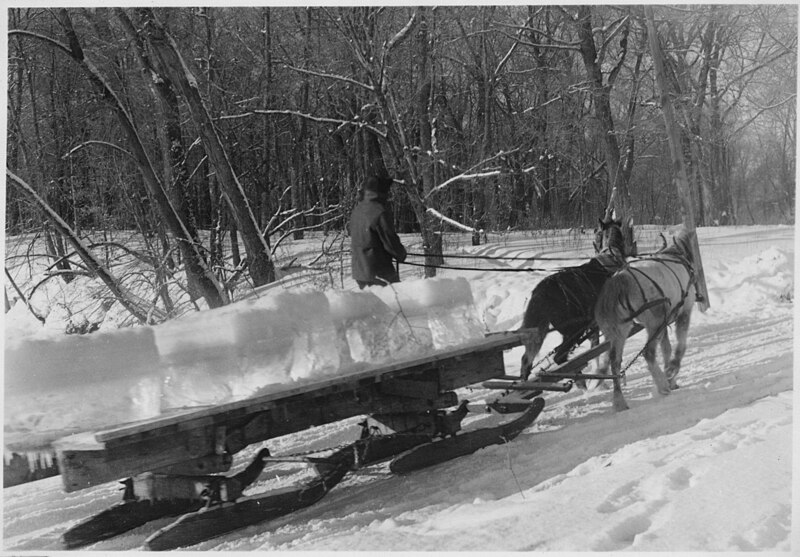
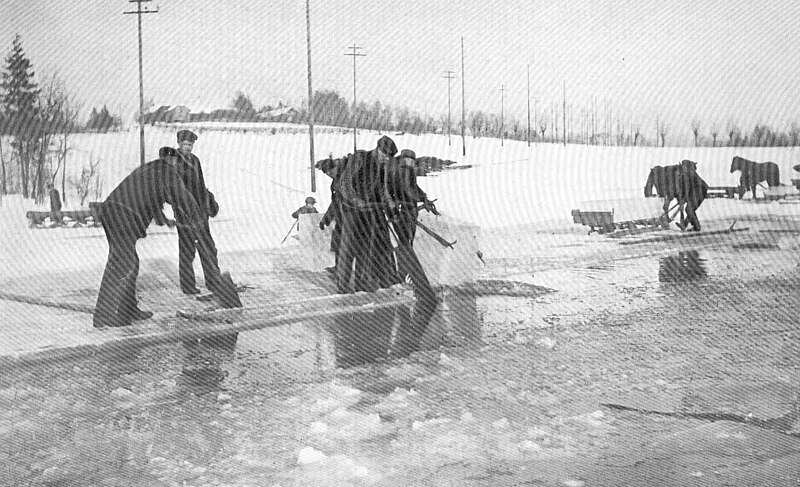
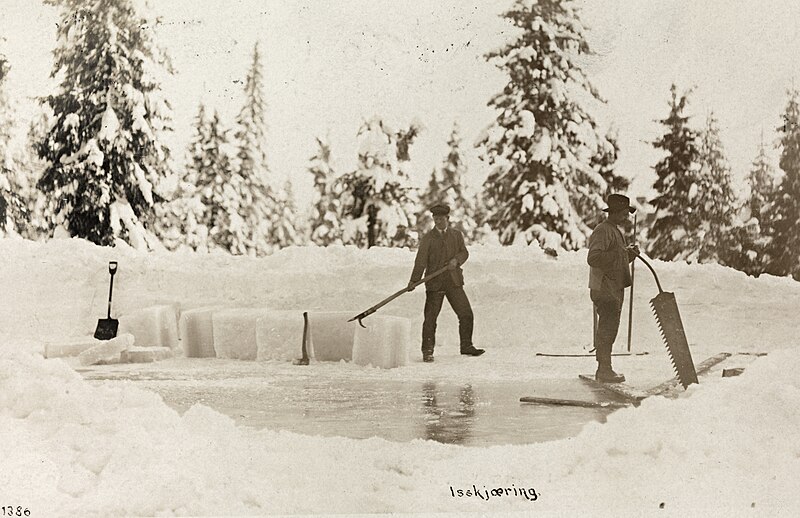
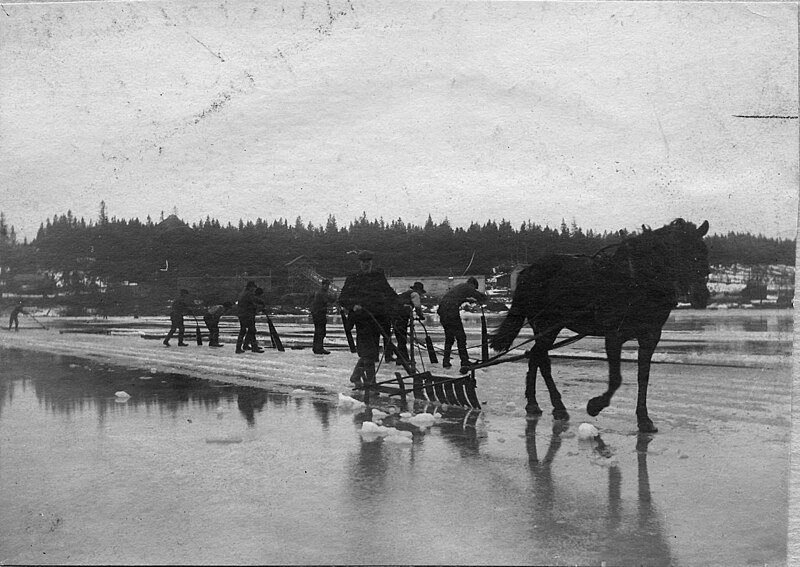
Photographs and illustrations from the age of ice harvesting. All images from Wikimedia Commons (public domain or Creative Commons).
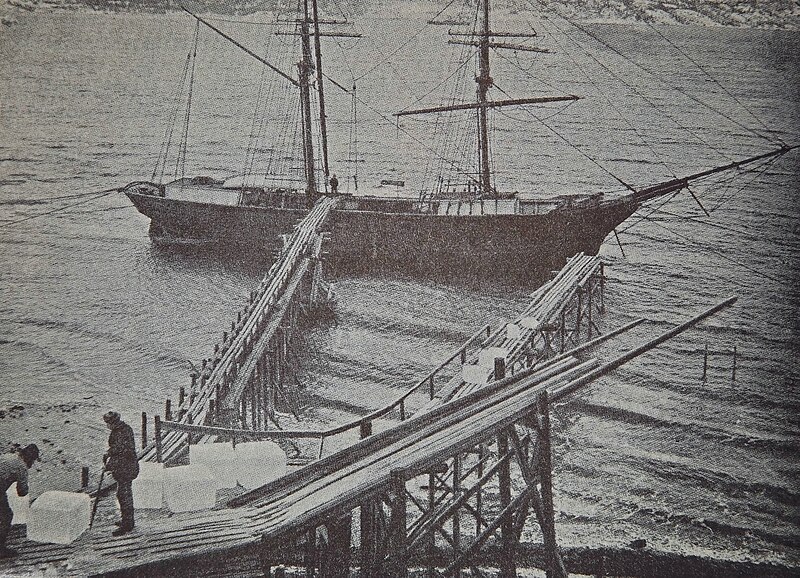
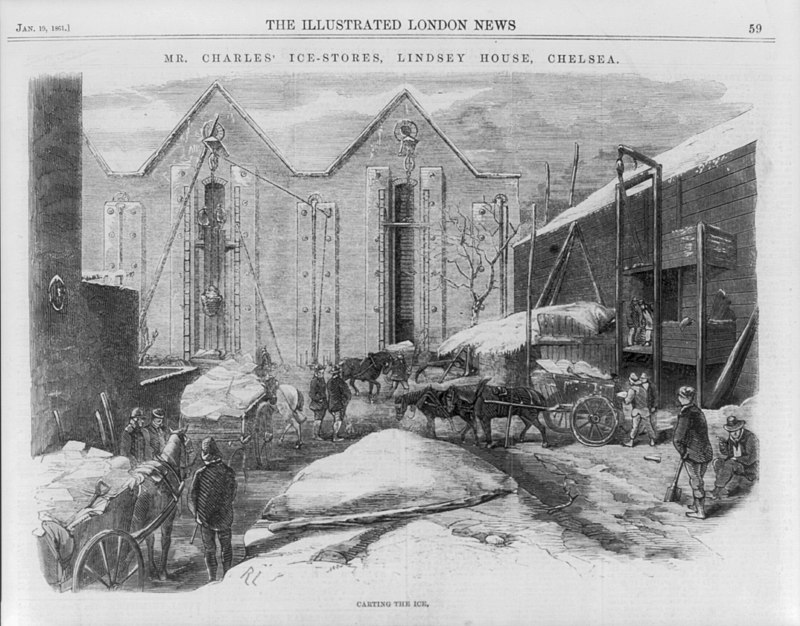
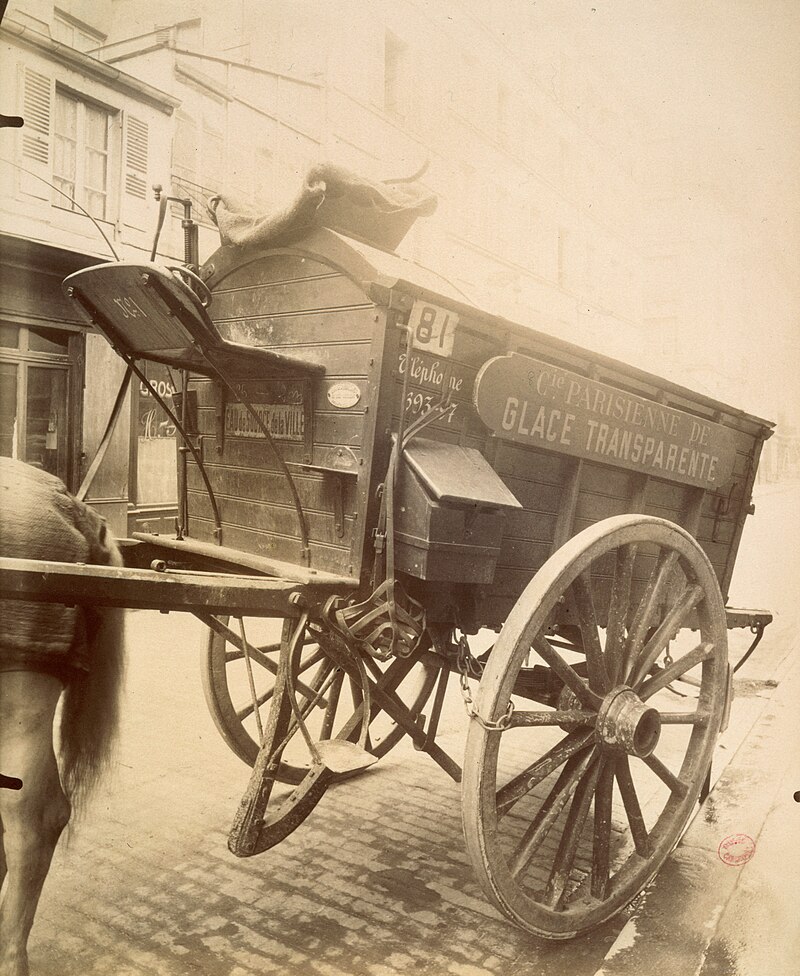
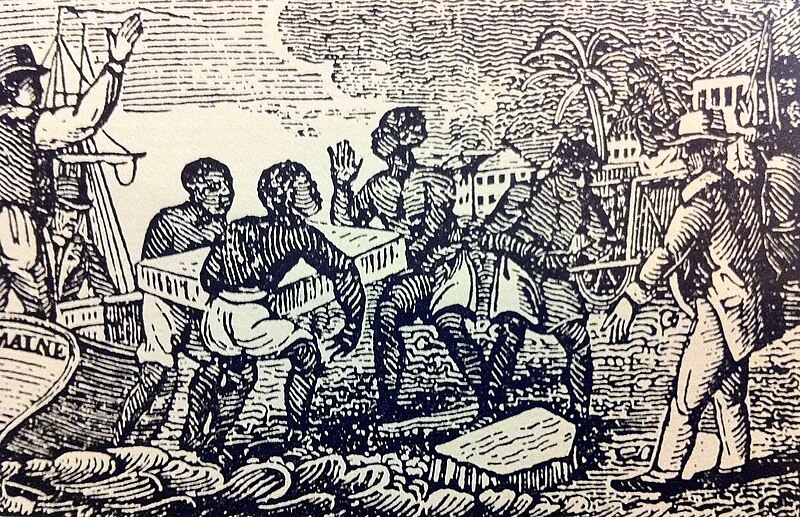
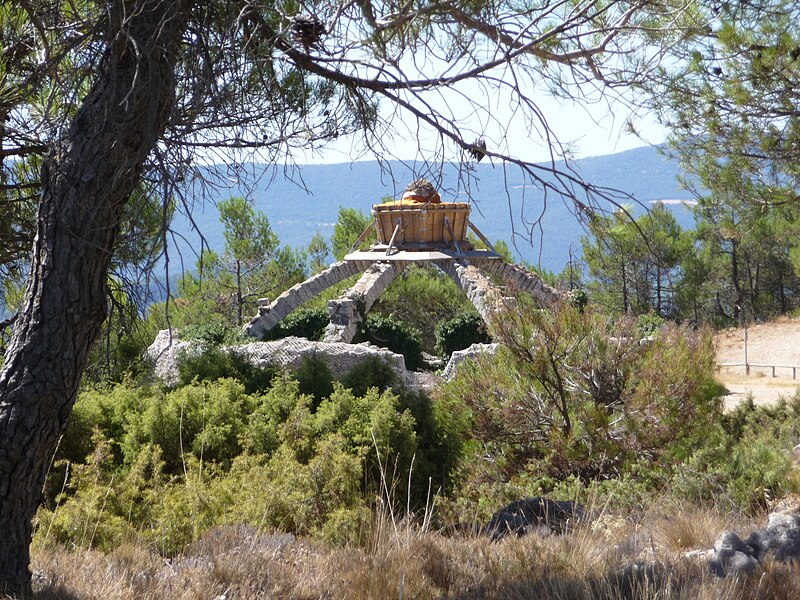
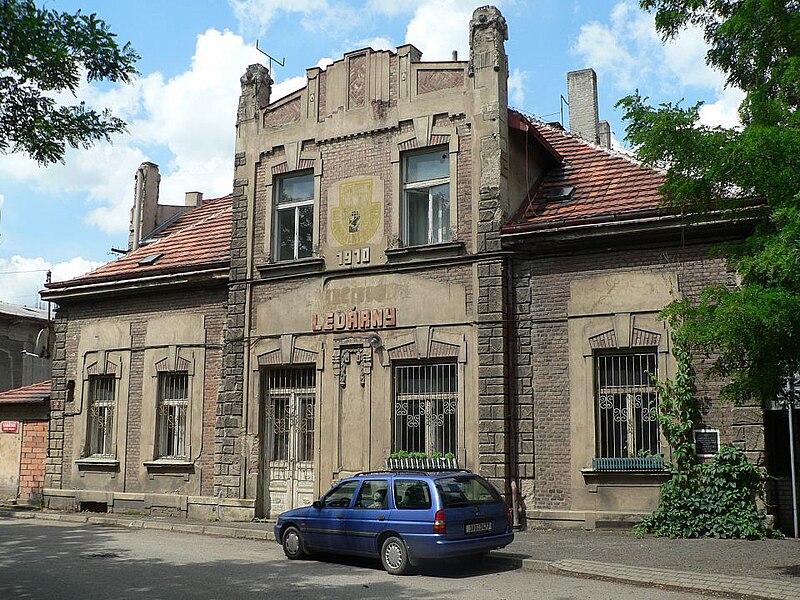
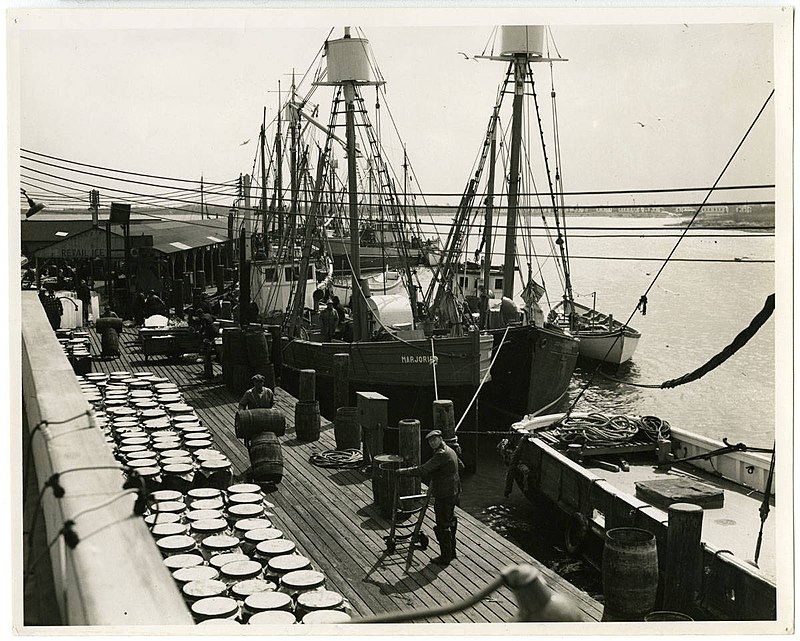
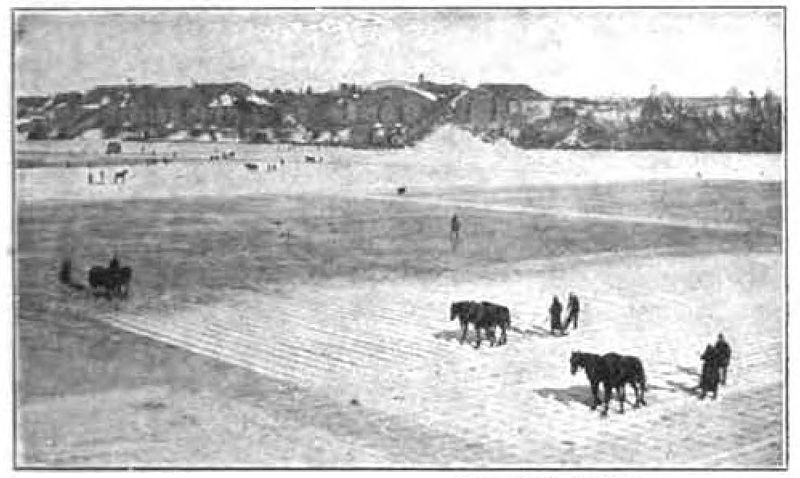
Timeline
The Science of Ice
Ice Quality & Crystal Structure
Not all ice was created equal. Hard, clear, crystalline ice — free of air bubbles and impurities — was the most prized for consumption and commanded premium prices. White, porous ice was less valuable and relegated to industrial use.
In calm lakes and ponds, ice forms as hexagonal plates and needles in clear, uniform layers. This slow-frozen lake ice was denser, more transparent, and lasted longer than fast-frozen river ice, which forms under turbulent conditions trapping air and sediment. Michael Faraday tested Wenham Lake ice and found it so pure from salts and air bubbles that it could withstand higher temperatures than regular ice without melting. A newspaper could be read through a 2-foot-thick block.
Approximately 1,000 tons of ice could be harvested per acre of water surface.
Water Source Matters
The source of water profoundly affected ice quality:
- Spring-fed ponds (like Wenham Lake) — purest, clearest ice; premium product
- Lakes — generally good quality; calm water allows uniform crystal formation
- Rivers — faster current produces cloudier ice with trapped sediment; also vulnerable to sewage contamination
- Brackish bays — in Helsinki, Baltic Sea ice with low salinity was harvested, but fresh water ice from the River Vantaa was far more valuable
- Glaciers — extremely dense and pure; Swiss Grindelwald glacier ice was prized across Europe
Weather Requirements
Ice needed to reach a minimum of 30 cm (12 inches) thick before commercial harvesting could begin — though 18 inches (46 cm) was preferred for the weight of horses and equipment. Sustained temperatures well below freezing were needed for 2–6 weeks to build sufficient thickness.
The harvesting season was narrow: typically January to March in New England, December to February in Norway. Czech ledari had active seasons of only 2–3 weeks. If winter was too warm, the entire year's supply was lost — triggering devastating "ice famines."
Ice Famines
Warm winters periodically devastated the industry:
- 1860 — first Hudson River ice famine; shortages drove up prices
- 1872 — ice-free winter in Austria; 100 million kg imported from Poland by rail for Dreher's breweries
- 1889–90 — one of the warmest winters on record; Hudson harvests failed entirely; NYC used 3 million tons/year but couldn't source it
- 1894 — Chicago had "no more than a day's worth of ice for the whole city" on July 4th
- 1898 — mild Norwegian winter forced Britain to seek supplies from Finland
- 1906 — ice prices reached 40 cents/ton in New York
These crises accelerated the adoption of mechanical refrigeration, as businesses and cities realised they couldn't depend on nature.
Contamination & Health
As cities grew and rivers became sewers, ice quality became a public health crisis. In the late 1800s, New York State used coliform testing to demonstrate that sewage contamination of the Mohawk River had caused typhoid fever in people consuming ice from the Hudson downstream.
Ottawa's Board of Health passed regulations in the early 1890s restricting ice harvesting to above the Chaudiere Falls due to pollution. The contamination crisis further undermined public trust in natural ice and bolstered the case for factory-made alternatives.
The Little Ice Age Connection
The commercial ice trade coincided with the tail end of the Little Ice Age (c. 1300–1850), a period of regionally cold conditions. This natural climate pattern ensured reliable winter freezing across northern Europe and North America — the very conditions that made the industry possible. As the Little Ice Age waned and global temperatures began rising, the industry's dependence on nature became increasingly precarious.
Ice Harvesting Around the World
The ice trade touched every continent. Click on a country to learn its story.
🇺🇸 United States Birthplace of the global ice trade
The Ice King
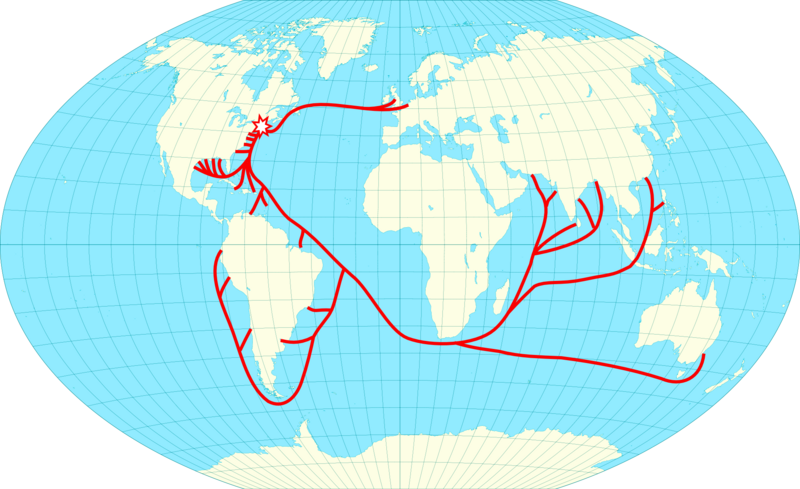
The commercial ice trade was born in Boston. Frederic Tudor (1783–1864), known as "The Ice King," launched the industry in 1806 when he shipped ice from his father's farm in Saugus to the Caribbean. Despite early losses and imprisonment for debt, Tudor built a global empire with ice houses in Havana, Jamaica, New Orleans, Charleston, Calcutta, Bombay, Singapore, Hong Kong, and Rio de Janeiro.
New England & the Hudson Valley
The heartland of American ice was the Hudson River Valley. By the 1880s, an estimated 20,000 workers harvested ice between Poughkeepsie and Albany, storing it in 135 purpose-built ice houses along the riverbanks. The work was seasonal and dangerous: subzero temperatures, high winds, the risk of falling through the ice, or being struck by 100-pound blocks.
Wenham Lake in Massachusetts became so famous for its crystal-clear ice that Norwegian exporters renamed a lake in Norway "Wenham Lake" to cash in on the brand. The Wenham Lake Ice Company received a royal warrant from Queen Victoria.
The Knickerbocker Ice Company
Founded in 1831 at Rockland Lake by John J. Felter and partners, Knickerbocker harvested the cleanest, purest ice in the Hudson Valley. By the 1850s, the company owned a dozen steamboats and 75 ice barges, employing about 3,000 people. Its three ice houses held nearly 100,000 tons. In 1902, Thomas Edison filmed its operations. The company declined by 1900 as artificial ice emerged.
Western Expansion
Ice harvesting followed the railroads west. Truckee, California became a major ice-producing centre, supplying the rapidly growing cities of the Pacific coast.
Key Numbers
- 90,000 workers at peak (late 1890s)
- Industry capitalised at $28 million
- Ice was the #2 US export after cotton
- 146,000 tons shipped to India in 1856 (peak year)
- New York City consumed ~285,000 tons of ice per year
- Americans consumed over 5 million tons annually
- NYC had over 1,500 ice delivery wagons
- Large operations: crews of 75 cutting 1,500 tons daily
🇳🇴 Norway Europe's ice supplier
Norway became the largest ice exporter in the world, surpassing the United States by the 1870s. Norwegian glacier ice was exported to Britain from around 1820, and by 1850, Norway was the UK's dominant supplier.
Scale of Operations
Norwegian ice exports peaked in the 1890s, when one million tons were exported annually. The trade was initially centred on the fjords of the west coast but shifted south and east to align with the timber and shipping industries. By 1895–96, Coastal Telemark alone had 1,300 workers exporting 125,000 tons; Nesodden employed 1,000 men exporting 95,000 tons by 1900. Key export destinations were England and Germany.
Artificial lakes up to half a mile long were built on farmland — some even extending into the sea to collect fresh water. Ice cutting was typically done at night when ice was thickest.
The British Connection
Norwegian ice dominated the London market for the last 40 years of the 19th century. The major importer, the Leftwich company, kept a thousand tons in store at all times. Ice was shipped to Regent's Canal Dock and stored underground in ice wells.
Curious Fact
In the early 1860s, Lake Oppegard in Norway was officially renamed "Wenham Lake" to confuse consumers into thinking they were buying the prestigious American product.
🇨🇿 Czech Republic (Bohemia & Moravia) Brewers, ledari, and the Vltava
Ice harvesting in the Czech lands — known as ledarstvi — was intimately connected to the brewing industry. Czech breweries required 50–200 kg of ice per hectolitre of beer produced, making reliable ice supply essential. The practice has medieval roots: archaeological finds of oyster shells in Prague, Brno, Komorni Hradek, Veseli nad Moravou, and Plasky Monastery confirm a medieval ice-dependent food trade.
The Ledari of Prague
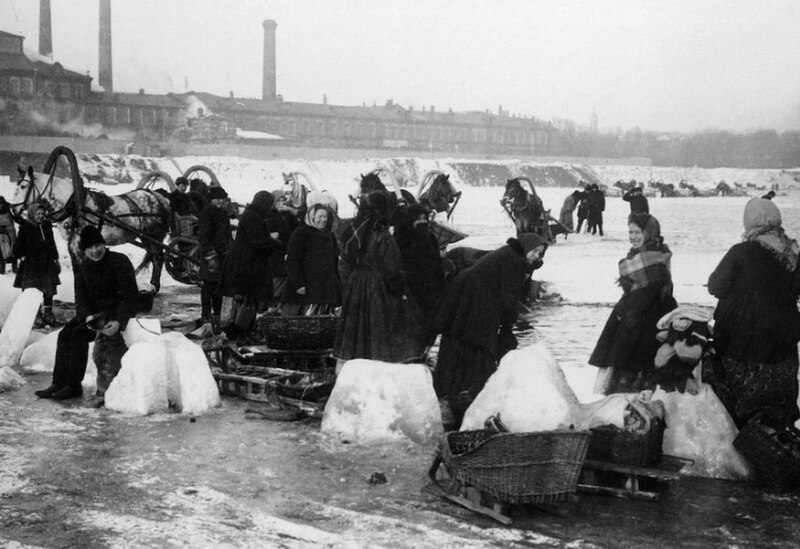
Professional ice harvesters called ledari worked on the frozen Vltava every winter. The primary harvesting zone stretched between Smichov and the Sitkovsky mills, where the river water was considered cleanest. According to 1906 records, over 100,000 cartloads of ice were transported from Prague's riverbanks in a single winter, employing approximately 550 men.
Ledari were organised in teams of 10–12 men with specialised roles: two cutters, a floater, a splitter, a pusher, a factor, two haulers, throwers, a builder, and a sweeper. The most skilled workers came from Podskalí, a historic riverside neighbourhood. In summer, many worked as vorari (raftsmen) on the same river. The ice had to be at least 30 cm thick before harvesting could begin, and the active season lasted only 2–3 weeks.
Branicke Ledarny — Prague's Ice Cathedral
The largest ice storage facility in Bohemia was the Branicke ledarny (Branik Ice Houses), built 1909–1911 by architect Josef Kovarovic for the Akciove ledarny company, founded by Prague's innkeepers and restaurateurs. The location was chosen because it was one of the coldest spots in the Vltava valley. The complex featured:
- Storage capacity of 20,000 tons of ice
- One of the first buildings in Prague to use a reinforced concrete skeleton
- Cork insulation within cavity walls with air gaps
- Sophisticated ventilation, water drainage, and three elevators
- Horse stables, an administrative villa, and caretaker's residence
- An artificial lagoon extending ~50m inland from the main channel, where workers controlled water flow to create thicker, faster-freezing ice
Operations ended in 1954 when the Slapska Dam, part of the Vltava Cascade, prevented the river from freezing. The complex on Ledarska Street is now a protected cultural monument (since 1964).
Jundrovske Ledarny — Moravia's Ice Houses
In 1884, Eduard Alfred Paget purchased land in Jundrov (Brno) for a wooden ice storage facility. By 1885 it was sold to "The Prague and Brunn Ice Company," which built an ice house 42 m long, 24 m wide, and 11 m high with three interior floors and a capacity of 500 wagon-loads. In 1888, Julius Brauner, brewmaster of Starobrnensky pivovar (Starobrno Brewery), purchased it. By 1910, three wooden ice houses had grown up in Jundrov, supplying Brno's inns, butchers, breweries, and confectioners.
Brewery Ice Houses
Czech brewery ice cellars (lednice) were sophisticated structures with large windows for loading ice blocks (sealed with straw and bricked shut after filling), access hatches for summer extraction, and wooden grates to separate ice from meltwater. Insulation materials included straw, sawdust, peat, diatomaceous earth, and cork bricks treated with asphalt. One cubic metre of ice weighed 917 kg; storage density reached 600–700 kg per cubic metre of cellar space.
Breweries and Their Ice Sources
- Plzensky Prazdroj (Pilsner Urquell) — ice from Bolevecky rybnik pond; a railroad spur was built in 1883 to transport ice to the brewery cellars; an iron conveyor was installed in 1942 extracting 100 tons/hour; in 1920, the brewery required 600 railroad cars of ice for 400,000 hl of production; last ice block harvested in 1987 — one of the latest documented uses of natural ice in European brewing
- Branicke pivovar, Prague — adjacent to the Branicke ledarny on the Vltava
- Starobrno, Brno — supplied by Jundrov ice houses on the Svratka River
- Pivovar Strakonice — located directly on the Otava River for convenient ice supply
- Pivovar Tabor — ice from Sudomerice pond, transported by horse-drawn wagon
- Pivovar Cerna v Posumavi — founded 1568 by Jakub Krcin; used Jestrabi, Novy Mlyn, and Olsovsky ponds; by 1931 had six cellar spaces totalling 5,000 m³, requiring 400–500 railroad cars of ice annually and employing 40 workers in ice season
- Stvanice island, Prague — 19th-century ice houses, modernised in 1911
The Last Freeze
In January 1947, during severe frosts, approximately 1,200 wagon-loads of ice were harvested from the Vltava in just four weeks. At the Branik facility, ice was 35–40 cm thick. The last time the Vltava completely froze in Prague was in 1956 — the ice was so thick that brewery horses pulling beer wagons from the Branik brewery could walk across to Zlichov. Remarkably, Plzensky Prazdroj continued harvesting natural ice from Bolevecky pond until 1987.
🇬🇧 United Kingdom The great importer
Britain's mild climate meant it could never produce enough ice domestically. London wanted ice in far greater quantities than the British climate provided. While some ice was gathered from lakes and even the Regent's Canal, the quality was poor and quantity small.
American Ice Arrives
Ice imports from the United States began in the 1840s. The Wenham Lake Ice Company sent its first shipment to Liverpool in 1844 and opened offices across Great Britain and Ireland. They displayed a two-foot square ice block in their Strand shop window during summer — a sensation in Victorian London. The company received a royal warrant from Queen Victoria.
Carlo Gatti and Norwegian Ice
The transformation came with Carlo Gatti, a Swiss-Italian immigrant who brought his first shipment of 400 tons of Norwegian ice to London in 1857. Gatti built two enormous brick-lined ice wells on Regent's Canal — each 30 feet in diameter and 42 feet deep. Norwegian ice dominated the London market for the last 40 years of the century.
Ice was carried by ship to Regent's Canal Dock (now Limehouse Basin), then by canal barge to the ice wells at King's Cross. From there, horse-drawn carts delivered ice across London. One of the ice wells survives today as the London Canal Museum.
Scale
The Leftwich company, a major importer, kept 1,000 tons in storage at all times. Norwegian ice was cheaper than American ice, eventually pushing the Wenham Lake company out of the British market.
🇮🇳 India Tudor's most profitable market
India was the most dramatic destination of the global ice trade. On 12 May 1833, the brig Tuscany sailed from Boston with 180 tons of ice bound for Calcutta. When it approached the Ganges in September, many believed the delivery was an elaborate joke — but 100 tons had survived the four-month voyage.
The Calcutta Ice House
The British community in Calcutta built a grand stone Ice House to store the imported ice. Tudor's competitors soon entered the market, shipping to both Calcutta and Bombay and driving out most indigenous ice dealers.
Profitability
Calcutta remained enormously profitable: Tudor alone made more than $220,000 ($4.7 million in today's money) between 1833 and 1850. Exports to India peaked in 1856 with 146,000 tons shipped.
Traditional Indian Ice-Making
India also had its own ancient ice-making technique. Around 500 BCE, Indians placed water in porous clay pots on beds of straw; rapid evaporation under the cool night sky could chill water and, under the right conditions, create thin layers of ice.
Decline
The natural ice trade to India faltered during the Indian Rebellion of 1857 and gradually gave way to mechanical ice production in the late 19th century.
🇷🇺 Russia The Ice Palace and the Neva
Russia's relationship with ice is legendary. The mighty Neva River in St. Petersburg provided abundant ice, and Russian ice-cutting techniques were highly refined.
The Ice Palace of 1740
The most spectacular use of harvested ice in history was Empress Anna Ivanovna's Ice Palace, built during the brutally cold winter of 1739–40 (temperatures reached -40°C). Military personnel hauled blocks of the clearest Neva ice, each weighing 120 kg, measured with compasses and rulers, and assembled with cranes.
The palace was 60 feet wide and 30 feet tall. Everything was carved from ice: windows, furniture, tables, doors, and an exact replica of the empress's bedchamber with an ice bed, ice canopy, ice pillows, and ice sheets. The palace celebrated Russia's victory over the Ottoman Empire. By June 1740, it had melted into blocks floating in the river.
Commercial Ice Trade
Russia's harsh winters made natural ice abundantly available domestically, reducing the need for a large-scale export trade. However, ice harvesting from rivers and lakes was a common winter occupation across the country, supplying local markets, estates, and food preservation needs.
🇸🇪 Sweden Scandinavian ice traditions
Sweden participated in the Scandinavian ice trade alongside Norway, though on a smaller scale. The coastal Swedes, along with Finns and indigenous Sami people, developed cultures and food systems that have relied on their knowledge of ice since the end of the last Ice Age, some 10,000 years ago.
Swedish ice was harvested from frozen lakes and rivers for domestic use and some export. The country's long, cold winters made ice readily available, and the practice supported local food preservation before the advent of mechanical refrigeration.
🇫🇮 Finland Baltic ice and the Vantaa
Finland played an important supporting role in the Scandinavian ice trade. In Helsinki, ice was harvested from two distinct sources:
- Baltic Sea bays — the brackish water with very low salinity in the shallow bays surrounding the city
- River Vantaa — the more valuable fresh water ice, harvested near the rapids where the river was widest
The river ice harvesting was concentrated in fishing communities, whose members took up ice work during winter months. During the mild winter of 1898, when Norway's ice production fell short, Britain turned to Finland for supplementary supplies.
🇨🇦 Canada The St. Lawrence and the Thousand Islands
Canadian ice harvesting centred on the St. Lawrence River and the Great Lakes region. Large chunks of ice were cut from the frozen river and transported to ice houses for year-round storage.
Methods
In the early years, ice was cut by hand using saws and axes, then transported by horse-drawn sleds. By the late 19th century, steam-powered ice-cutting machines operated on the frozen expanse of the St. Lawrence — a risky undertaking given the machine's bulk on the ice.
Ice Houses
Canadian ice houses were typically small, double-walled buildings, with the better ones having inner walls filled with cork or sawdust for insulation. Ice was a vital commodity in the Thousand Islands region, supporting local industries alongside boat building and stone quarrying.
Ontario
Ontario had a significant ice harvest history, with operations on numerous lakes and rivers across the province supplying cities and towns before mechanical refrigeration arrived.
🇩🇪 Germany Berlin — Europe's ice-hungry capital
From the 1850s onward, ice cutting took on large-scale industrial proportions in Germany, with Berlin as the key market. Germany was one of the largest consumers of ice in continental Europe.
Brewing Connection
Lager beer, enormously popular in Germany, requires cold temperatures during the brewing process. Bavarian breweries harvested ice from the Nymphenburger Canal and the Eisbach in Munich. In mild winters, ice was cut from the Birnhorn glacier and hauled into the valley via wooden chutes, then transported to Munich by train. Trees (especially chestnut trees) were planted above beer cellars — their thick foliage and shallow roots helped keep the vaults cool. In 1870, Carl von Linde developed the first large-scale refrigerated lagering tanks for the Spaten Brewery in Munich, beginning the end of ice dependence.
Medical Uses
Ice was also vitally important in the growth of German medicine, where complications from surgical procedures were significantly reduced with the use of ice for cooling and preservation.
Norwegian Imports
As US ice exports diminished after 1870, Norway shipped large quantities to Germany. In years when German lakes didn't freeze sufficiently, Norwegian demand would soar.
🇨🇳 China 3,000 years of ice administration
China has one of the oldest documented histories of organised ice harvesting in the world.
Ancient Practices
During the Shang Dynasty (1600–1046 BCE), ice was already used for preservation and cooling. By around 1000 BCE, the Chinese were cutting and storing natural ice from frozen lakes and rivers. The Zhou Rites record that the Zhou royal court established a specialised "ice administration" department with 80 employees who collected ice blocks each December and transported them to ice houses for storage.
Imperial Privilege
Ice was a mark of status: senior officials were awarded ice cubes by the royal court — considered a great honour. Underground chambers and specially constructed ice pits, insulated with straw and other materials, preserved ice into the warmer months.
The Songhua River
The Songhua River in northeastern China has a long tradition of ice harvesting, practised as a ceremony that continues to this day as part of the famous Harbin Ice Festival.
Tudor's Reach
By the 1840s, Frederic Tudor's ice was reaching China: ships carried New England ice to Hong Kong, making the American ice trade truly global.
🇯🇵 Japan Sacred ice and the himuro tradition
Japanese ice harvesting has deep spiritual and cultural roots. The practice is intertwined with religious values — ice from sacred lakes was used in ceremonies representing purity and coexistence with nature.
Himuro — Ice Houses
Ice farmers and storage houses are called himuro. During the early Showa period (1926–1945), there were nearly 100 himuro throughout Japan. Today, only five remain — three of them in Nikko.
The Craft
When ice grows to about 15 cm thick, it is cut with a power cutter, pulled from the water, and stored in the himuro. The entire process is done manually. Ice is covered with sawdust — an ancient preservation method that absorbs surface moisture and insulates against melting.
Kakigori
Japan's beloved kakigori (shaved ice dessert) has roots in the Heian period (794–1185), when it was a luxury enjoyed only by the aristocracy who had access to stored ice. Today, the finest kakigori is still made with naturally harvested ice from Nikko.
🇮🇹 Italy From sherbet to gelato
Italy's ice traditions bridge ancient Roman practices and the birth of modern ice cream. Wealthy Romans imported Alpine snow for cooling beverages, and this tradition never entirely died.
Renaissance Revival
In the 16th century, Italians revived the use of ice on a broader scale. Wealthy Neapolitans of the late 17th century enjoyed Italian ice and sherbets — a practice adopted from the Turkish Empire. Ice was stored in vaults, commonly at the foot of mountains.
Cultural Export
Italy exported the culture of ice to France — the French borrowed the tradition of using ice, initially as an extravagance of the wealthy. The Italian Carlo Gatti later became London's most important ice merchant, building the famous ice wells on Regent's Canal.
🇨🇭 Switzerland Glacier ice for Europe
Switzerland's Alpine glaciers provided a unique source of high-quality ice for the European market.
Grindelwald
By the 1870s, hundreds of men were employed to cut ice from the glaciers at Grindelwald in the Bernese Alps. This glacier ice, prized for its purity and density, was shipped across Europe.
Paris Connection
Paris began importing ice from Switzerland and the rest of Europe in 1869, creating a major market for Alpine ice.
🇦🇹 Austria The Vienna Ice Company
Austria entered the European ice market behind Norway, but developed its own significant operations. The Vienna Ice Company exported natural ice to Germany by the end of the 19th century, leveraging Austria's cold Alpine winters and proximity to the German market.
Austrian breweries, like their Czech neighbours, relied heavily on natural ice for the lager brewing process.
🇳🇱 Netherlands Canals, the Little Ice Age, and ice management
The Netherlands has a unique relationship with frozen water. The country's extensive canal network made ice both a resource and a logistical challenge.
Ice Removal on Waterways
Historical records from 1330 to 1800 document the complex management of ice on Dutch waterways. During the Little Ice Age (roughly 1300–1850), canals froze regularly, disrupting vital water transport but also enabling the famous Dutch tradition of ice skating.
The Elfstedentocht
The Elfstedentocht (Eleven Cities Tour), a 200 km skating race through Friesland, symbolises the Dutch relationship with natural ice. The race can only be held when canals freeze to a safe thickness — it has been held only 15 times since 1909, most recently in 1997.
🇫🇷 France Parisian ice imports
France borrowed the tradition of using ice from Italy in the 16th century, initially as an extravagance of the wealthy. French aristocracy used ice to cool drinks and preserve food, building glacieres (ice houses) on their estates.
In 1869, Paris began to import ice from Switzerland and the broader European market, fuelling demand for Alpine glacier ice from Grindelwald and other sources.
🇪🇸 Spain Pozos de nieve — snow wells in the mountains
Spain developed a distinctive system of pozos de nieve (snow wells) across its mountain regions, active from the 16th through the early 20th century.
Sierra Espuna
The Sierra Espuna range in Murcia alone had 23 wells, each capable of holding up to one million kilos of ice. Snow was compacted in layers separated by thick layers of straw (wheat, oats, rye; vine shoots when straw was scarce), then transported by horse and carriage to cities between May and September. About 35% of the ice melted before reaching its destination.
Royal Privilege
In 1684, King Carlos II granted a royal privilege for Los Pozos de la Nieve in Seville. In January 1700, a historic harvest involved 70–80 people working on mountaintops for five days of uninterrupted work to fill the wells. Snow wells were also found in Jumilla, Yecla, Cieza, Abanilla, Fortuna, Caravaca de la Cruz, and Cartagena.
Canary Islands
Spanish colonisers brought the technology to the Canary Islands, where ice stored in caves and deep pits could reportedly last up to two years.
🇮🇷 Persia / Iran Yakhchals — ancient desert ice houses
Perhaps the most remarkable ice storage structures in history are the Persian yakhchals (literally "ice pits"), dating to around 400 BCE.
Design
Yakhchals were dome-shaped structures with deep subterranean storage chambers. Their walls were made of a special mixture called sarooj — a composite of sand, clay, egg whites, lime, goat hair, and ash — extremely thick, waterproof, and heat-resistant.
How They Worked
Water was channelled into shallow basins that froze overnight in the desert cold (desert nights can drop well below zero even in warm climates). The ice was then cut into blocks and stored underground. Found primarily in the Dasht-e Lut and Dasht-e Kavir deserts of modern Iran, Afghanistan, and Tajikistan.
Lasting Legacy
The Persian word yakhchal is still the modern word for "refrigerator" in Iran, Afghanistan, and Tajikistan.
🇵🇱 Poland Lodownie, boiling-water technique, and emergency exports
Poland had a significant ice harvesting tradition, with purpose-built ice houses called lodownie — typically underground chambers on shaded hills, with stone or wooden walls, double insulation with straw, metal grating floors for drainage, and arched ceilings covered with earth and moss.
A Distinctive Technique
Polish ice workers developed a unique method: crushed ice was doused with boiling water, fusing the fragments into one enormous block that melted far more slowly than smaller pieces.
Major Exporter in Emergencies
During the "ice-free winter" of 1872, approximately 100 million kg of ice had to be imported by rail from Poland to supply Anton Dreher's Austrian breweries — a crisis that ultimately prompted Dreher to commission Professor Carl von Linde to develop mechanical refrigeration.
Urban Ice Subscriptions
In pre-war Poland, urban residents could purchase monthly ice subscriptions from commercial ice companies. A 1929 Lodz ice house advertised rapid delivery with subscription discounts. The Anstadt brewery in Lodz relied on adjacent fish ponds for ice supply.
🇭🇺 Hungary The frozen Danube and Dreher's cellars
The frozen Danube has been historically significant in Hungarian ice use — King Matthias Corvinus was reportedly crowned on Danube ice. The river freezes solidly enough in severe winters for foot crossings (and ice jams triggered Budapest's catastrophic Great Flood of 1838).
Dreher's Kobanya Brewery
Anton Dreher's brewery complex in Kobanya (Budapest), one of the largest in the Habsburg Empire, maintained massive ice cellars for lager production. In 1841, Dreher constructed ice cellars at his Schwechat brewery (near Vienna) covering 8,632 m², storing an astonishing 40,000 metric tons of ice. His Budapest operations would have been similarly equipped.
Birth of Mechanical Refrigeration
It was the 1872 ice crisis — when Dreher's breweries couldn't get enough natural ice — that drove him to commission Carl von Linde's cooling machine, installed at his Trieste brewery in 1877 and then at Schwechat. Dreher became the first brewer to adopt artificial cooling.
🇰🇷 Korea Seokbinggo — stone ice storage houses
Korea has one of the most architecturally sophisticated ice storage traditions in Asia. Seokbinggo (literally "stone ice storage") are ingenious structures where ice blocks cut from frozen lakes were stored through the summer.
Ancient Origins
The earliest record of a binggo in Korean history dates to the Three Kingdoms Period (57 BCE – 668 CE). By the Joseon Dynasty (1392–1897), ice storage became a state-managed operation with elaborate infrastructure.
Joseon Dynasty Ice Infrastructure
King Taejo (founder of Joseon, r. 1392–1398) ordered construction of two major ice houses in Seoul: Seobinggo (Western Ice Storage) near the Han River for the palace kitchens, and Dongbinggo (Eastern Ice Storage) for court funerals. Workers cut blocks 12 cm thick and 1.8 m long from the frozen Han River. The government issued bingpae (ice ration tickets) based on rank. Royal funerals alone required approximately 15,000 ice blocks.
Gyeongju Seokbinggo
The most famous of seven surviving seokbinggo (all designated national treasures). Its engineering is remarkable: an arched granite ceiling with air pockets, ventilation ducts (wide at base, narrow at top) to expel warm air, limestone-coated walls to repel moisture, tilted floors for meltwater drainage, dried seaweed insulation, and grass planted on the earthen roof.
Bingsu
Korea's beloved bingsu (shaved ice dessert) traces its origins to the Joseon Dynasty, when stored ice was shaved and served with sweet toppings — a luxury for the aristocracy.
🇹🇷 Turkey / Ottoman Empire Mountain snow and karsambaç
The Ottoman Empire had a formalised, institutional snow trade under the Karhane-i Amire ("Royal Snow Authority"). Professional snow gatherers called karci collected the cleanest new snow and compressed it in underground snow wells, insulated with felt and straw. The Ottomans were obsessed with cold drinks, sherbets, and chilled desserts. Constantinople also received Norwegian ice imports in the 19th century.
Karsambaç & Dondurma
A distinctive snow-based drink called karsambaç originated in the Karamanmaras region. When salep (powdered orchid tubers) was added, the famous stretchy Maras dondurma (Turkish ice cream) was born — one of the few ice-based foods that predates mechanical refrigeration and survives to this day.
🇲🇽 Mexico Volcano ice and the Snow Monopoly
Mexico's ice tradition predates European contact. The Mexica (Aztec) people extracted ice and snow from the volcanoes Popocatepetl and Iztaccihuatl, with trained porters (tamemes) making two-day journeys from Tenochtitlan to the base of the mountains — a practice dating to the reign of Moctezuma Xocoyotzin (1502–1520).
Spanish Colonial Control
By 1620, Spanish authorities created a "snow monopoly" (estanco de nieve) to control the lucrative trade. The ice was wrapped in ixtle (agave fibre) and animal hides. Mexico's first commercial ice cream maker, Leonardo Leanos, emerged in the 17th century. The introduction of the Italian garrafa method — two nested containers with salted ice between them, constantly rotated — eventually democratised access. Nieves de garrafa remain beloved across Mexico today.
🇧🇷 Brazil Tudor's South American frontier
Brazil was one of Tudor's global trade destinations. Beginning in 1834, New England ice was shipped to Rio de Janeiro, where it arrived after weeks at sea. The ice trade brought cooling to the tropical Brazilian elite long before local manufacturing became viable.
🇸🇬 Singapore Whampoa Ice House
In 1854, merchant Hoo Ah Kay (known as Whampoa) partnered with Gilbert Angus to import American ice, operating the Ice House at Boat Quay. The venture struggled, selling only 400–500 lbs/day (1,000 needed to break even). The Tudor Ice Company took control in 1861 but lost ~$20,000.
Local Manufacturing Wins
That same year (1861), Singapore Ice Works opened on River Valley Road — the first to produce ice locally at 3 cents/lb (2 cents cheaper than imported). Competition intensified: the Straits Ice Company (1881) drove prices to 1.5 cents/lb. By 1903, the Cold Storage Company dominated. Tuck Lee Ice (founded 1924) still operates today with modern robotics.
🇵🇪 Peru Living tradition — Andean glacier ice harvesting
Peru is remarkable for having one of the last living traditions of natural ice harvesting in the world. For centuries, Indigenous communities in the Andes have harvested glacier ice for ceremonial and practical purposes.
Qoyllur Rit'i
The annual Qoyllur Rit'i pilgrimage to the Sinakara glacier near Cusco traditionally included the ritual of carrying blocks of glacier ice back down the mountain — ice believed to have sacred healing properties. As glaciers retreat due to climate change, this centuries-old tradition is being reshaped, highlighting the direct connection between ice harvesting and environmental change.
🏴 Scotland Salmon, ice houses, and the Tugnet
Scotland's ice trade was driven by the salmon fishing industry. Fresh salmon exports to England's industrial cities created huge demand for ice storage.
The Tugnet Ice House
The Tugnet Ice House (built 1830) on the River Spey is the largest surviving ice house in the United Kingdom. It stored ice for packing salmon before market shipment. Glasgow had multiple ice houses, and around 1802, entrepreneur William Harvey set up ice houses beneath a bridge across the St Enoch Burn.
Norwegian Imports & Local Manufacturing
Norwegian ice was imported into Scotland until the 1920s. The Scottish Cold Storage & Ice Company opened in Glasgow in the late 1890s using ammonia compression, but suffered a catastrophic pipe burst in September 1898 that killed three workers. Wellpark Brewery (Tennents) had its own ice engine house by 1898.
🇪🇨 Ecuador Baltazar Ushca — the last hielero
Ecuador is home to perhaps the most poignant story in the history of ice harvesting. Baltazar Ushca (died October 11, 2024, age 80) was the last ice merchant of Mount Chimborazo (Ecuador's highest peak at 6,263m).
A 50-Year Tradition
For over 50 years, Ushca made the journey twice a week using just his hands and a pickaxe, cutting glacial ice, wrapping it in straw for insulation, and loading it onto donkeys for the descent. He started at age 15, following a family tradition spanning generations. He never wore gloves.
At its peak, up to 40 ice merchants made the journey. By the end, Ushca was the only one left — his brothers had retired for steadier work. After his death, Ecuador's National Institute of Cultural Heritage honoured him as "a reference for the knowledge of our people."
🇱🇰 Sri Lanka (Ceylon) From Tudor's ice to Ceylon Cold Stores
Natural ice from New England was imported and auctioned at Colombo harbour — the "white glittering chunks" were available only at functions and houses of the socially privileged. Tudor maintained ice houses in Sri Lanka among his many locations.
Local Manufacturing
In 1866, the Colombo Ice Company was founded with imported ice-making machinery, initial capital of GBP 1,600, two steam engines, and 22 employees. Located on Glennie Street, Slave Island, the area became locally known as "Kompaniveediya" (Ice Company area). The company evolved through multiple owners into Ceylon Cold Stores — still operating today as one of Sri Lanka's oldest companies.
🇦🇺 Australia Where mechanical ice won earliest
Australia's extreme distance from ice-producing regions (115-day sea journeys from New England) made it the place where manufactured ice displaced natural ice earliest.
First shipments of American ice arrived in 1839. But by the 1850s, James Harrison had built an ice plant in Melbourne that dominated the local market. Harrison's commercially viable refrigeration system, built in Geelong in 1854, was one of the first in the world, making Australian artificial ice competitive well before most other markets.
🇨🇺 Cuba & Caribbean Tudor's first markets
The Caribbean was where the global ice trade began — and failed, and then succeeded. Tudor's first shipment went to Martinique in 1806, followed by Havana, which became his biggest and most reliable market.
By 1816, Tudor was shipping ice to Cuba with increasing efficiency, experimenting with insulating materials (wood shavings, sawdust, rice chaff). Ice was used to chill drinks in elite bars and, crucially, in hospitals to treat fevers and aid in surgeries. Tudor also shipped to Jamaica, Haiti, and other Caribbean islands.
The Complete Process: From Frozen Lake to Your Door
1. Site Selection & Preparation
The best ice came from clean, still water. Spring-fed ponds and sheltered lakes were preferred over rivers. Before cutting began, the entire field was cleared of snow with horse-drawn scrapers — snow acts as insulation and slows ice formation. Workers then tested ice thickness with augers; a minimum of 30 cm (12 inches) was required, though 18 inches was preferred for horse safety.
In Prague, the primary harvesting zone stretched between Smichov and the Sitkovsky mills, where the Vltava water was cleanest. At the Branicke ledarny, workers controlled water flow in an artificial lagoon to grow thicker, faster-freezing ice.
2. Marking & Scoring
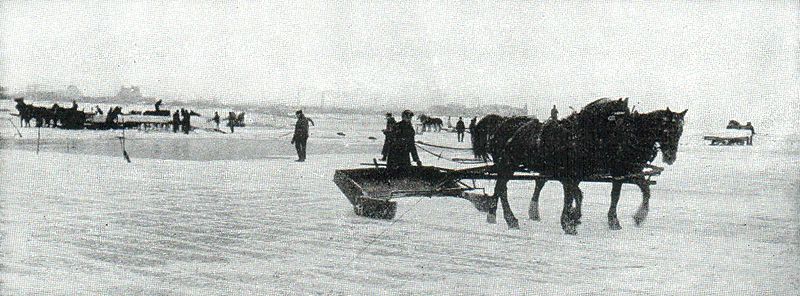
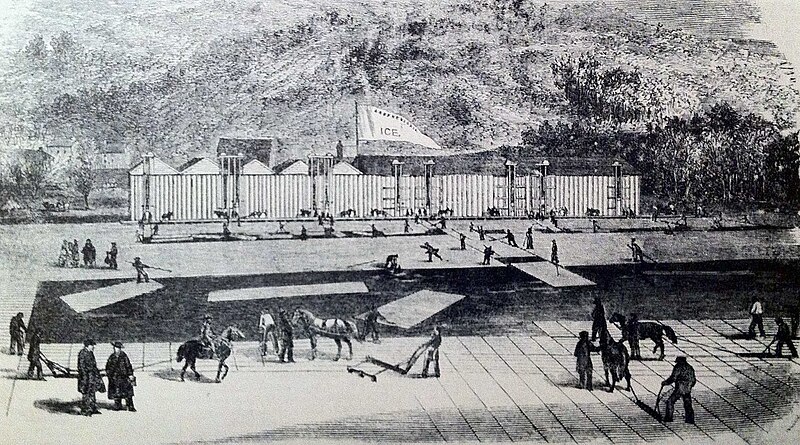
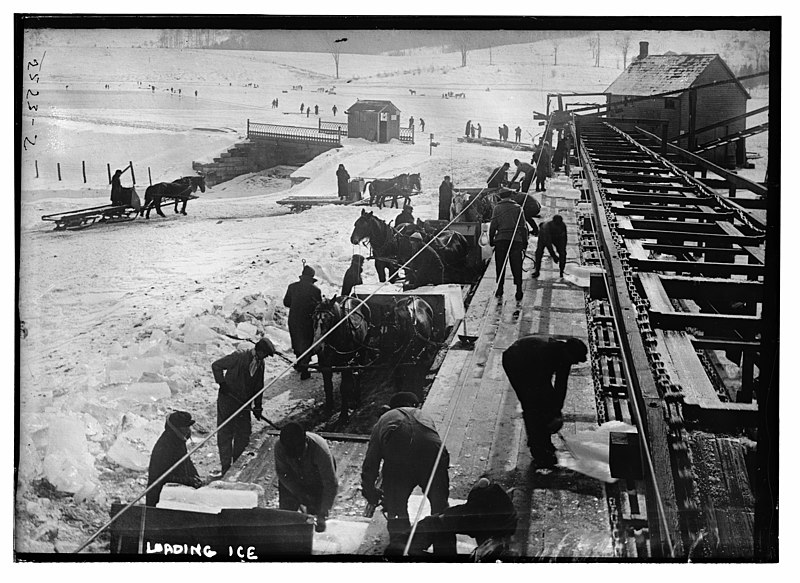
A channel marker was pulled across the ice to scratch guidelines. Then the horse-drawn ice plow — Nathaniel Wyeth's revolutionary invention — scored deep parallel grooves, creating a grid of uniform rectangles. Horses wore special calked shoes (shoes with sharp metal studs) to grip the ice surface. The plow cut grooves 4–6 inches deep but not through the full thickness.
3. Cutting & Breaking
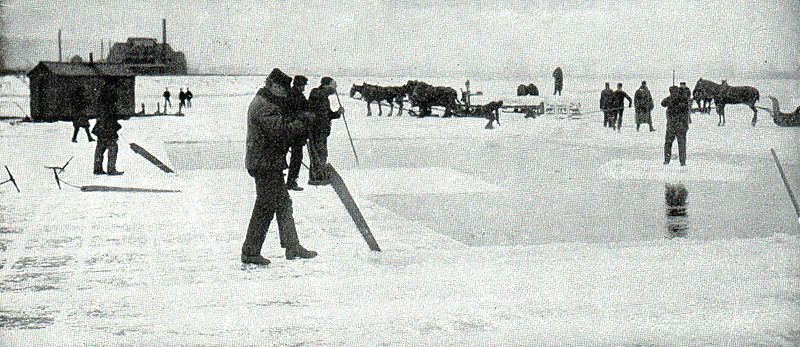
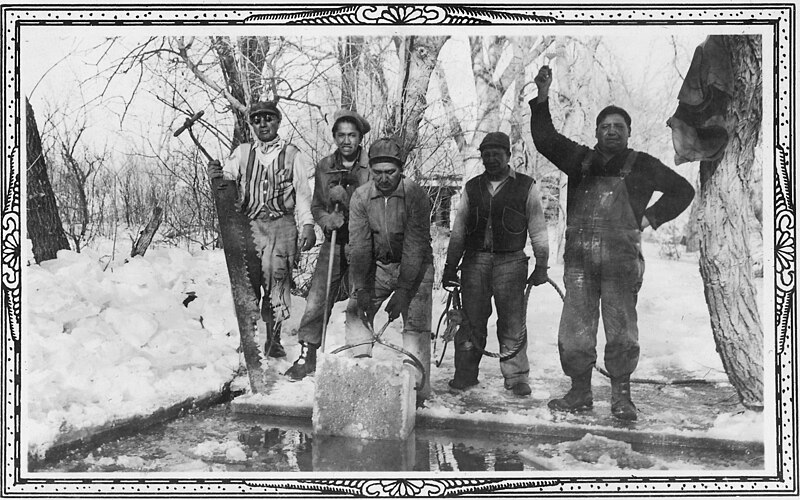
After scoring, workers with ice saws (long, heavy crosscut saws with one end running into the water) finished cutting through the full thickness. The blocks — typically 22 inches square and 12–18 inches thick, weighing 200–300 pounds each — were separated with breaking bars and pike poles, then floated down cleared channels toward the ice house.
By the late 19th century, motor-driven saws, conveyor systems, and steam-powered cutters were deployed. On the St. Lawrence River in Canada, massive steam-powered cutting machines operated directly on the frozen surface. At Bolevecky pond (Pilsen), an iron conveyor installed in 1942 could extract 100 tons per hour.
4. The Tool Kit
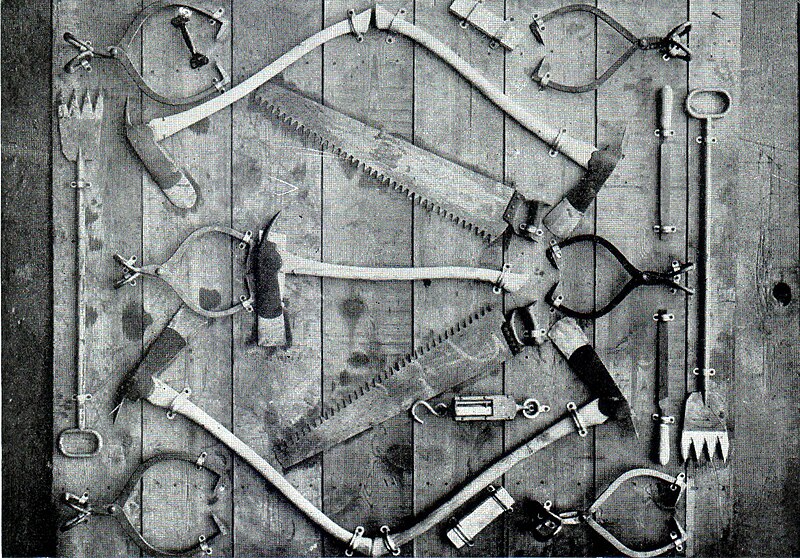
- Ice plow — horse-drawn; scores parallel grooves in uniform grids
- Ice saw — long crosscut saw for finishing cuts through full thickness
- Pike pole — long pole with a metal hook for guiding floating blocks
- Breaking bar — iron bar for prying scored blocks apart
- Ice tongs — large pincer-like grips for lifting and moving blocks
- Ice chisel — for detail work, trimming, and testing
- Channel marker — scribes guidelines for the plow to follow
- Calked horse shoes — metal-studded horseshoes for ice traction
- Ice shaver — smooths block surfaces for tighter stacking
- Ice scales — for weighing blocks during sale and delivery
5. Storage & Preservation
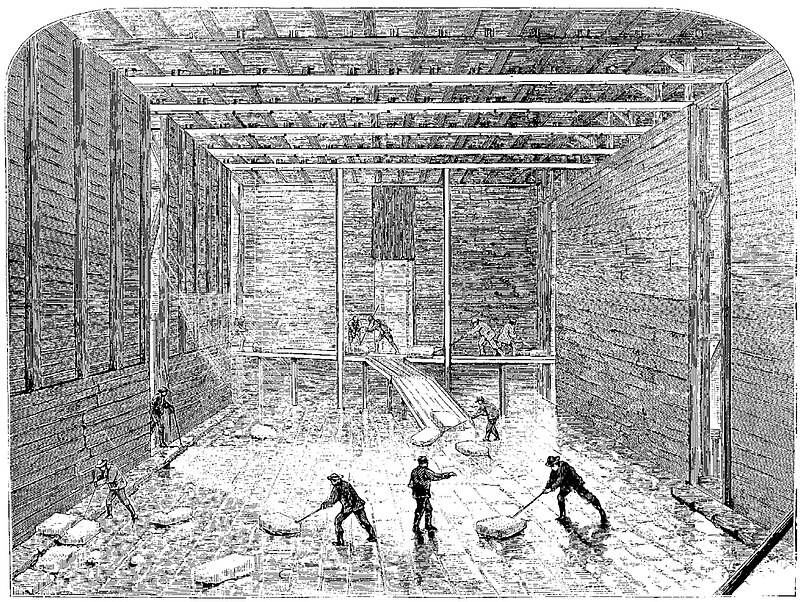
Ice houses ranged from small double-walled wooden buildings to industrial complexes like Prague's Branicke ledarny (20,000-ton capacity) or a commercial ice house storing 2,700 tonnes in a 9×30m, 14m-high building. British ice houses were typically brick-lined, domed structures with most volume underground. Key insulation materials:
- Sawdust — the most common; air trapped between particles insulates brilliantly
- Straw and chaff — cheap and widely available
- Rice chaff/hulls — used on ships; naturally fire-resistant, moisture-resistant, and fungus-proof
- Cork bricks (treated with asphalt) — most effective; used at Branicke ledarny
- Peat and diatomaceous earth
Blocks fused together into one giant mass through a technique of flooding water between layers — or in Czech breweries, spraying stored ice with salt water. The slight melting and refreezing compacted the mass, improving storage density to 600–700 kg per cubic metre. In Poland, a distinctive technique involved dousing crushed ice with boiling water, fusing fragments into an enormous single block that melted far more slowly. Ice stored properly would remain frozen for many months, often until the following winter.
6. Transport & Shipping Routes
Ice moved by horse-drawn sleds in winter, then by wagon, canal barge, railroad, and oceangoing ship. Insulating cargo holds with sawdust was critical. Major routes and wastage rates:
- Boston → Martinique (1,500 mi) — 3 weeks; Tudor's first route (1806)
- Boston → Calcutta (~16,000 mi) — 4 months; 100 of 180 tons survived (44% loss)
- Norway → London — by ship to Regent's Canal Dock, then canal barge to ice wells; ~25% weight loss
- Boston → Rio de Janeiro — from 1834
- New England → Hong Kong, Singapore, Sydney — 115-day journeys to Australia
In the 1820s–30s, only 10% of harvested ice reached the end user. By the late 19th century, better insulation reduced wastage dramatically.
Railroads & Refrigerator Cars
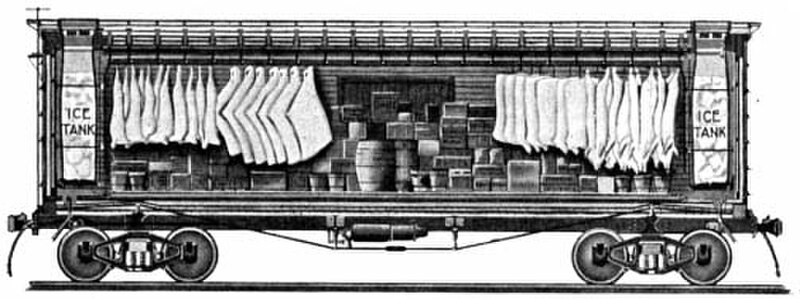
The railroad transformed domestic ice distribution. Refrigerator cars emerged in the late 1850s, requiring re-icing every 250–400 miles. Top-icing a 40-foot reefer required over 10,000 lbs (4,500 kg) of ice. The Pacific Fruit Express alone produced 1,200 tons of ice daily at its Roseville, California plant and could service 254 cars at its docks. Industry-wide, 1.3 million tons of ice were produced annually for refrigerator car use alone.
7. The Iceman & Home Delivery
The last mile of the ice trade was the iceman — a daily fixture of urban life from the 1870s to the 1950s. In 1879, the Consolidated Ice Company alone operated 3,000 horse-drawn ice wagons in New York City. Blocks were cut into 25lb, 50lb, and 100lb sizes for household delivery. Families placed cards in their windows indicating how much ice they wanted; the iceman carried blocks up tenement stairs with tongs.
In Prague, heavy horse-drawn wagons from the Branik facility distributed ice year-round. The deliveries sometimes blocked sidewalks and disrupted electric tram service.
8. The End: Artificial Ice & Refrigeration
The techniques that killed the natural ice trade emerged over decades:
- 1834 — Jacob Perkins builds first practical refrigerating machine (ether vapour compression)
- 1844 — John Gorrie first mechanically produces ice (Tudor runs a smear campaign)
- 1854 — James Harrison builds first commercially viable system (Melbourne)
- 1870 — Carl von Linde develops brewery refrigeration for Spaten, Munich
- 1877 — Dreher installs Linde's machine — first brewer to adopt artificial cooling
- 1914 — manufactured ice surpasses natural ice in the US
- 1918 — WWI diverts ammonia to munitions; natural ice harvesting temporarily revives
- 1927 — GE's Monitor Top refrigerator brings mechanical cooling to homes
- 1950 — 90% of American city homes have refrigerators
- 1987 — Plzensky Prazdroj harvests its last block of natural ice
Dangers, Scandals & Economics
A Deadly Occupation
Ice harvesting was among the most dangerous seasonal occupations in 19th-century America. Workers faced:
- Falling through the ice — the most feared danger; in dark, frigid water under a ceiling of ice, survival time was minutes
- Sharp tools — responsible for the majority of injuries; ice saws, chisels, and pikes caused deep lacerations
- Being struck by ice blocks — 200–300 pound blocks could crush limbs or knock workers into open water
- Machinery entanglement — conveyor belts, steam-powered cutters, and elevator chains maimed workers
- Subzero temperatures & high winds — frostbite and hypothermia were constant companions
Despite the danger, the pay attracted workers whose main jobs — farming, brickmaking, sailing — were unavailable in winter.
The Ice Monopoly Scandal
Charles W. Morse, known as "the Ice King" of the Gilded Age, used Tammany Hall corruption to establish a monopoly over New York's ice supply. In 1899 he merged several companies into the American Ice Company, then engaged in price gouging that hit the city's poorest residents hardest. The scandal became a political crisis, exposing the intersection of essential commodity control and machine politics. Morse later caused the Panic of 1907 through his financial manipulations.
Economics of Ice
The economics transformed over the century:
- Harvesting cost: dropped from 30¢/ton to 10¢/ton after Wyeth's plow
- Consumer price: ice dropped from 6¢/pound to 0.5¢/pound by the 1830s
- 1890 prices: $10/ton in NYC, $20/ton in Cincinnati, $5–7.50/ton in Savannah
- Alaskan ice: $75/ton in 1851 (extreme distance premium)
- Tudor's India profits: $220,000 over 17 years (~$4.7M today)
- Industry peak: $28 million capitalisation, 90,000 workers (1890s US)
- By 1900: ice harvesting was the 9th largest US industry by financial terms
Environmental Impact
Large-scale ice harvesting was not without ecological consequences. Removing hundreds of thousands of tons of ice from lakes and rivers altered:
- Water levels — heavy extraction lowered lake levels noticeably
- Aquatic ecosystems — ice cover protects freshwater ecosystems in winter; removing it exposed fish and organisms to temperature extremes
- Riverside landscapes — 135 ice houses lined the Hudson between Poughkeepsie and Albany, dramatically altering the riverscape
However, unlike most extractive industries, ice harvesting was inherently renewable — the resource regrew every winter.
Stories & Curiosities
Remarkable tales, forgotten characters, and surprising connections from the world of ice — from secret wartime experiments to the unlikely origins of convenience stores.
People & Untold Stories
Thomas Moore’s Icebox (1802)
The first icebox was invented by Maryland farmer Thomas Moore to transport butter to market. His ingenious design — a cedar tub containing a tin container insulated with rabbit fur — let him sell firm butter bricks while his competitors arrived with melted tubs. Moore coined the term “refrigerator” and published a pamphlet promoting his invention.
Agnes Marshall, “Queen of Ices”
In 1880s England, Agnes Marshall was the first person ever to suggest using liquid nitrogen to make ice cream — over a century before molecular gastronomy became fashionable. She also patented an ice cream maker, published two bestselling cookbooks, and toured Britain giving cooking lectures to packed audiences.
Presidential Ice Cream
George Washington spent approximately $200 on ice cream in the summer of 1790 alone. Thomas Jefferson had an 18-step handwritten ice cream recipe. Dolley Madison served ice cream at the 1813 Inaugural Ball, cementing it as an American institution.
Italian Immigrant Icemen
Many of New York City’s icemen were Southern Italian immigrants. Playwright Arthur Miller recalled them wearing “leather vests and a wet piece of sackcloth slung over the right shoulder,” hauling dripping blocks up tenement staircases through the sweltering summers.
Simon Greenleaf’s Ice Rights (1841)
The famous legal scholar Simon Greenleaf adjudicated heated disputes over Fresh Pond ice rights in Cambridge, Massachusetts. The ice boom was so intense that land around the pond surged from $130/acre to $2,000/acre, turning a quiet pond into prime real estate almost overnight.
Military Uses of Ice
Project Habakkuk — The Ice Aircraft Carrier
During WWII, the British planned to build a 2,000-foot aircraft carrier made of pykrete (14% sawdust mixed with 86% ice). Secret experiments were conducted beneath Smithfield Meat Market in London, hidden behind frozen animal carcasses. A 1,000-ton prototype was built on Patricia Lake in Alberta, Canada — it took three hot summers to fully melt.
Mountbatten’s Pykrete Demo
At the 1943 Quebec Conference, Lord Mountbatten shot a block of pykrete with a revolver to demonstrate its bullet-resistant strength. The bullet ricocheted off the frozen block and grazed Admiral Ernest King’s trouser leg, lodging in the wall. The demonstration was deemed a success regardless.
Civil War Ice Supply
Maine merchant James L. Cheeseman supplied ice to the Union Army, keeping field hospitals and food stores viable. When Northern ice shipments to the South were cut off, Ferdinand Carré’s ice-making machines were imported to New Orleans to serve Confederate hospitals.
“Ice Girls” of WWI
With men away at the front, women were employed as ice delivery workers for the first time, hauling heavy blocks from horse-drawn wagons to homes and businesses — another of the war’s many quiet revolutions in gender roles.
WWII Ice Houses as Air Raid Shelters
Old British ice houses found an unexpected second life as air raid shelters during the Blitz. Their underground, thick-walled construction — originally designed to keep ice from melting — proved ideal for protecting civilians from bombing raids.
Industry & Commerce
7-Eleven’s Origin in Ice Houses
The world’s largest convenience store chain began as ice houses. In 1930s Texas, the Southland Ice Manufacturing Company started selling groceries, eggs, and cold beer alongside ice blocks. Customers loved the convenience, and the ice docks gradually evolved into 7-Eleven stores.
Alaska–California Ice Trade (1851–1880s)
During the California Gold Rush, ice was imported from Russian-controlled Alaska at $75/ton. Aleutian teams were trained specifically to harvest ice for the trade. The business collapsed when transcontinental railroads made cheaper eastern ice accessible to the West Coast.
Gustavus Swift’s Canada Route
When US railroads refused to carry his refrigerator cars, meatpacker Gustavus Swift contracted with Canada’s Grand Trunk Railway to bypass them entirely. By 1920, his line operated 7,000 ice-cooled refrigerator cars. Henry Ford later credited visiting a Chicago slaughterhouse — with its ice-cooled overhead rail system — as inspiration for his assembly line.
The Soda Fountain Trust (1891)
The four largest soda fountain manufacturers formed a trust to monopolise the industry — and all of them depended entirely on harvested ice. No ice meant no cold sodas, making the ice supply chain a hidden chokepoint of Gilded Age commerce.
Disasters & Oddities
The 1910 Iceboro Fire
A devastating fire at American Ice Company facilities in Maine destroyed ice houses and schooners, causing $130,000 in damage (~$3.5 million today). The fire crippled Maine’s ice industry and accelerated the shift to manufactured ice. The irony of an ice empire destroyed by fire was not lost on contemporary reporters.
The Wisconsin Ice Wars (1900–01)
Disputes over ice harvesting rights on Wisconsin lakes escalated into pitched battles between rival companies. The conflict culminated in the deployment of a steamship icebreaker to deliberately smash through and destroy a competitor’s ice supply.
Natural Ice’s False Marketing
The Natural Ice Association promoted natural ice by exploiting the bogus belief that it melted more slowly than manufactured ice. The claim had no scientific basis whatsoever — but it was effective marketing that kept the natural ice industry alive longer than technology alone would have sustained it.
Archaeological Discoveries
2018 Park Crescent Ice Well (London)
Archaeologists uncovered a massive commercial ice well beneath Park Crescent in London — 9.5 metres deep and 7.5 metres wide — built around 1780, just metres from the Jubilee Line. It was later used by William Leftwich to store Norwegian imported ice.
King Zimri-Lim’s Ice House (c. 1780 BCE)
A cuneiform tablet records the King of Mari boasting about building an ice house in Terqa (modern Syria), declaring “which never before had any king built.” This is the earliest documented ice house attributed to a specific named ruler — a royal flexing over refrigeration nearly 4,000 years ago.
Scotland’s “Secret Tunnels”
Expert Bruce Walker suggested that Scotland’s many legends of secret tunnels on country estates actually originated from ruined, forgotten ice houses built into hillsides. Later generations — finding mysterious underground brick-lined passages — assumed they were escape tunnels rather than Georgian-era cold storage.
Visit: Ice Heritage Sites in Europe
Many historic ice houses, museums, and heritage sites across Europe can still be visited today. Here is a guide to the most notable ones.
🇬🇧 United Kingdom & Ireland 5 sites
London Canal Museum
London, England — The premier ice trade museum in Europe. Housed in a Victorian ice warehouse built 1862–63 for Carlo Gatti, the museum preserves one of the two original brick-lined ice wells (30 ft diameter, 42 ft deep) where Norwegian ice was stored. The second well is viewable via CCTV. Exhibits cover the ice trade, canal history, and Gatti's story.
canalmuseum.org.uk — 12-13 New Wharf Road, King's Cross, London N1 9RT
Tugnet Ice House
Spey Bay, Moray, Scotland — The largest surviving ice house in the UK, built in 1830 for the salmon fishing industry. Category A listed building. Now part of the Scottish Dolphin Centre. Free admission — walk through six chambers and admire the spectacular vaulted brick ceiling.
Scottish Dolphin Centre — 4 miles north of Fochabers
Hillsborough Castle Ice House
Hillsborough, County Down, Northern Ireland — A preserved ice house in the gardens of this Georgian royal residence. Visible during garden tours. Managed by Historic Royal Palaces.
hrp.org.uk/hillsborough-castle
Findhorn Village Icehouse & Heritage Centre
Findhorn, Moray, Scotland — Multiple underground arched chambers built over 150 years ago, storing ice for packing salmon to ship to London. Heritage centre across the road covers fishermen's lives. Free admission, open daily 2–5pm June–August, weekends May & September.
Lismore Castle Ice Houses
Lismore, County Waterford, Ireland — Two circular stone ice houses (c. 1790) built into a hillside by Edmund Foley for the Blackwater salmon fishery. Freely accessible outdoor site with interpretation boards.
🇫🇷 France 5 sites
Musee de la Glace (Ice Museum)
Mazaugues, Provence — The first international museum dedicated to ice, at the foot of the Sainte-Baume massif. Traces the history of ice manufacturing, preservation, and commercialisation from antiquity to the present through panels, objects, tools, films, and interactive stations. Visits are complemented by a trip to the nearby Glaciere de Pivaut.
Glaciere de Pivaut
Mazaugues, Provence — The most spectacular ice house in France: 23 metres high, 17.6 metres diameter, capable of storing 3,100 m³ of ice. Built in the 17th century as part of the Sainte-Baume ice industry that supplied Toulon. Accessible from the D95 road with parking; guided tours available.
Glaciere de Brouage
Hiers-Brouage, Charente-Maritime — A reconstructed 17th-century military ice house within the Citadelle de Brouage. Originally built 1688, reconstructed in 2000. The Duke of Richelieu used this ice to serve sorbets and supply the hospital. Visitable as part of the citadel tour.
Anciennes Glacieres de Strasbourg
Strasbourg, Alsace — A listed industrial ice factory (1897–1990) that produced up to 8,000 ice blocks per day for Alsatian beer exports. Three turbines visible through a glass roof from the footbridge. Full interior visits during European Heritage Days.
Glaciere de Dienay
Dienay, Burgundy — An 18th-century ice house on a feudal mound, restored in 2004. Panoramic terrace views. Freely accessible.
🇩🇪 Germany 4 sites
Eiskeller-Museum Bad Kreuznach
Bad Kreuznach, Rhineland-Palatinate — Housed in the former Tesch brewery (19th century). The cellar where ice was stored to cool beer in summer was rediscovered in 2008. Also features a collection of turn-of-the-century toys. Open year-round.
Eiskeller Altenberge
Altenberge, North Rhine-Westphalia — Former brewery cellars of the Beuing brothers. In 2004, a museum was opened with an above-ground building designed in the shape of an ice floe.
Eiskeller Ludwigsburg
Ludwigsburg, Baden-Wurttemberg — The largest preserved ice house of any palace complex in southern Germany, hidden in a steep hillside within the Blooming Baroque gardens.
Eiskeller Berlin-Spandau
Berlin — A former ice storage location along the Berlin Wall Trail, now a scenic stop-off on bike tours. Freely accessible.
🇪🇸 Spain 3 sites
Pozos de la Nieve, Sierra Espuna
Totana/Alhama de Murcia, Murcia — A complex of 28 snow wells built between the 16th and 20th centuries, the largest and best-preserved in Europe. Winner of the 2024 European Heritage Award / Europa Nostra Award. Two signposted hiking trails (Sendero de Pedro Lopez and Valle de Leyva-Collado Mangueta) allow visitors to explore them in a beautiful mountain setting.
Cava Gran, Agres
Agres, Valencia — A monumental truncated-cone snow well from the 17th–18th century in the Sierra de Mariola natural park. Listed as a Site of Local Interest. Accessible via hiking trails. There are also several other cavas in the surrounding area.
Pozos de la Nieve, Seville
Constantina, Seville province — Historic snow wells with royal privilege dating to 1684 under King Carlos II.
🇮🇹 Italy 3 sites
Ghiacciaia della Madonnina
Le Piastre, Pistoia Mountains, Tuscany — Part of the Montagna Pistoiese EcoMuseum's ice trail. A restored production building where visitors can observe the blocking system and millponds. Features a conical shape, straw roof, and dry stone walls up to 3 metres thick.
Antica Ghiacciaia, Sogliano al Rubicone
Sogliano al Rubicone, Emilia-Romagna — An 18th-century underground ice house where foodstuffs were stored using ice.
Ghiacciaia di Moncodeno
Lake Como area, Lombardy — A natural ice cave accessible via hiking trail, part of the Lake Como heritage network.
🇨🇿 Czech Republic 1 site
Branicke Ledarny (Branik Ice Houses)
Prague, Ledarska Street, Branik — The largest ice depot in Bohemia (1909–1911). A protected cultural monument since 1964 in late Art Nouveau industrial style. The complex is currently deteriorating and not regularly open to the public, but it hosts occasional cultural events, concerts, and open-air cinema (A-Park Ledarny Branik). Check event listings for access opportunities.
🇦🇹 Austria 1 site
Historischer Eiskeller, Brunn am Wald
Brunn am Wald, Lower Austria — The ice cellar of Brunn am Wald Castle was in operation until WWII and was renovated in 2005. The inside remains intact as it was ~60 years ago. Visitors can see how ice was cut from the castle pond in winter and stored in the central pit, with overflow openings allowing cold air into surrounding food storage corridors.
🇵🇹 Portugal 2 sites
Poco de Neve (Snow Well)
Funchal, Madeira — An igloo-shaped snow well, 8 metres deep, built in 1813 to store ice for hospitals, hotels, and ice cream production. Used until the first ice machines arrived in the early 20th century. Accessible via hiking trail.
Real Fabrica do Gelo (Royal Ice Factory)
Serra de Montejunto, Cadaval — A National Monument and one of the rarest examples of an ice factory in Europe. Operational 1741–1885, producing ice daily September–April for 120 years to supply Lisbon, the Royal House, and cafes. Classified as National Monument in 1997. Daily guided tours at 10:00, 11:00, 14:00, and 15:30 (Portuguese; full English exhibition available).
realfabricadogelo.pt — Tel: +351 262 777 888
🇨🇭 Switzerland 1 site
Grindelwald Glacier Heritage
Grindelwald, Bernese Alps — The Lower Grindelwald Glacier was commercially exploited for ice from 1860 to 1914. While the glacier itself has retreated dramatically, informational displays near the glacier document the ice export industry. The glacier trail passes through the landscape where hundreds of workers once cut and shipped ice across Europe.
🇧🇪 Belgium 2 sites
Hopital Notre-Dame a la Rose
Lessines, Hainaut — Founded in 1242, one of the last self-sustaining medieval hospital complexes in Europe. The glaciere (ice cellar) is described as "the first eco-fridge" — a well filled with ice in winter that reportedly still has ice in August. Part of a 20-room tour through 800 years of healthcare. Exceptional Heritage of Wallonia. Tue–Fri 9:00–18:00, Sat–Sun 9:30–18:30. Adults EUR 13.
Anciennes Glacieres de Saint-Gilles
Rue de la Glaciere, Brussels — Built in 1874 as the largest ice cellar ensemble in the Brussels region. Ice came from Norway and local frozen ponds. Preserves two small horse-drawn ice delivery carriages (used until 1966). Now artisan workshops; occasional open events. Listed in Brussels' architectural heritage inventory.
🇳🇴 Norway 2 sites
Berg-Kragero Museum
Kragero, Telemark — Regional museum documenting art, coastal culture, and the export of natural ice from Kragero. Houses the Wiborg papers from a major ice-exporting family. The ice operations around Kragero involved elaborate infrastructure including ice railways taking ice from lake to fjord edge.
Norwegian Maritime Museum
Oslo — Supervised the major research project "The Last Ice Age" (2018–2022) on Norway's ice export trade. Holds significant research materials. Check the museum's programme for current ice trade content.
🇵🇱 Poland 1 site
Zywiec Brewery Museum
Zywiec, Silesia — A brewery museum set in 18 historic ice cellars cut into a cliff — the original chambers where beer was stored with natural ice. Now 1,600 m² of exhibits covering 150 years of brewing history. Founded 1856 by Archduke Albrecht Friedrich Habsburg. Recognised as an anchor point on the European Route of Industrial Heritage (ERIH). Tours in Polish, English, German, and Czech (1.5–2.5 hours).
🇳🇱 Netherlands 1 site
Amerongen Castle (IJskelder)
Amerongen, Utrecht — One of the best-preserved castles in the Netherlands, with a historic ice house (ijskelder) in the grounds. Open Thu–Sun 11:00–17:00.
Sources & Further Reading
- Ice trade — Wikipedia
- Ice cutting — Wikipedia
- Frederic Tudor — Wikipedia
- Ledarstvi — Wikipedie (Czech)
- Branicke ledarny — Wikipedie (Czech)
- The Ice Import Trade — London Canal Museum
- The Glory Days of Hudson Valley Ice Harvesting — Scenic Hudson
- Industry History — Antique Ice Tool Museum
- Norwegian ice export — Evergreen Post
- Tracing the History of New England's Ice Trade — Boston University
- Jak se v Cesku ledarilo — Sciencemag.cz (Czech)
- Jak se v pivovarech uchovaval led — Pivovary.Info (Czech)
- Z Vltavy tezili led — Blesk.cz (Czech)
- The Ice King Cometh — Smithsonian Magazine
- The Anglo-Norwegian Ice Trade, 1850–1920 — LSE Working Paper
- Natural Ice Created by Nikko's Exquisite Water — SHUNGATE
- Ice harvesting on China's Songhua River — Our China Story
- Ice and water: Removal of ice on waterways in the Low Countries, 1330–1800 — Water History
- Ledarina, tezka drina — Vysehradskej.cz (Czech)
- Historie jundrovskych ledaren — Kvasny prumysl (Czech, scholarly)
- Knickerbocker Ice Company — Wikipedia
- Yakhchal — Wikipedia
- Pozos de Nieve — Snow Wells of Sierra Espuna
- Ice Harvesting in Norway — Norwegian Language Blog
- Keeping Your Food Cool — Smithsonian National Museum of American History
- Kdyz zamrzla Vltava — CtiDoma.cz (Czech)
- Gyeongju Seokbinggo — Wikipedia
- A Cool Business: The History of Ice-Making in Singapore — BiblioAsia
- Baltazar Ushca obituary — Washington Post
- Andean glaciers and Indigenous rituals — National Geographic
- Tugnet Ice House — Wikipedia
- Ceylon Cold Stores — Wikipedia
- Tools for Harvesting the Ice — Woods Hole Museum
- Charles W. Morse — Wikipedia
- Ice famine — Wikipedia